Heat styling tape-in extensions: safe temps and tools
The curling iron is heating up, the LED display reads 230 degrees Celsius, and your extensions are in for a rough morning. That temperature — the default on many styling tools and the setting most people reach for without thinking — is hot enough to soften acrylic adhesive, warp the weft base, and fry human extension hair that has already been processed twice before it reached your head. You will not see the damage immediately. The curl will hold, the style will look fine, and you will go about your day satisfied. But the bond that held that weft securely for three weeks is now marginally weaker, the adhesive tab slightly distorted, the hair cuticle one step closer to the kind of dry, frizzy roughness that no amount of conditioning reverses. Repeat this every morning for two weeks, and the wefts begin sliding, the ends begin splitting, and the install that should have lasted eight weeks starts failing at four. Heat is not the enemy of tape-in extensions — ignorance of heat is. And the difference between styling your extensions every morning for eight weeks without a problem and destroying them in a fortnight is a matter of about 50 degrees and a few habits that no one explains until the damage is already done.
What heat does to extension adhesive
The adhesive used in tape-in extensions is a pressure-sensitive acrylic polymer that achieves its full bond strength through a combination of mechanical interlocking with the hair cuticle and chemical adhesion activated by heat during application. The flat iron used during installation — set to 180 to 200 degrees Celsius for three to five seconds per weft — is what activates the polymer and creates the bond. This means the adhesive is designed to respond to heat, and any subsequent heat exposure has the potential to affect the bond — either positively or negatively.
At application temperatures of 180 to 200 degrees, applied for a few seconds, the adhesive activates and flows into the cuticle surface. At temperatures above 200 degrees, or at lower temperatures applied for longer durations, the adhesive begins to soften beyond its functional range. The polymer chains that give the bond its strength relax, the adhesive loses its grip on the cuticle, and the bond weakens. This softening is not permanent if the heat is brief — the polymer re-hardens as it cools. But repeated exposure to high heat causes cumulative degradation: each cycle of softening and re-hardening slightly alters the polymer structure, making the bond progressively weaker.
The critical temperature threshold for tape-in adhesive is approximately 200 degrees Celsius. Below this temperature, brief contact with a styling tool does not significantly affect the bond. Above 200 degrees, the adhesive softens enough that even brief contact can cause distortion, and prolonged contact can cause the bond to fail entirely. This is why the maximum recommended styling temperature for tape-in extensions is 180 degrees — a 20-degree safety margin below the adhesive's softening point.
What heat does to extension hair
The hair in tape-in extensions is human hair, but it is not the same as the hair growing from your scalp. Natural hair receives continuous moisture and oil from the scalp, which keeps the cuticle lubricated and resilient to heat. Extension hair is disconnected from this supply the moment it is cut from the donor, and by the time it reaches your head, it has been washed, conditioned, and possibly colored — processes that compromise the cuticle's protective layer.
The cuticle damage cascade
Heat styling damages hair by lifting the cuticle — the outermost layer of overlapping scales that protects the inner cortex. When a hot tool passes over the hair, the heat causes the moisture inside the cortex to expand and push outward, lifting the cuticle scales. At moderate temperatures with a heat protectant, this lifting is temporary and the scales settle back down. At high temperatures, or without protection, the lifting becomes permanent: the scales remain raised, the cortex is exposed, and the hair becomes dry, rough, and prone to tangling.
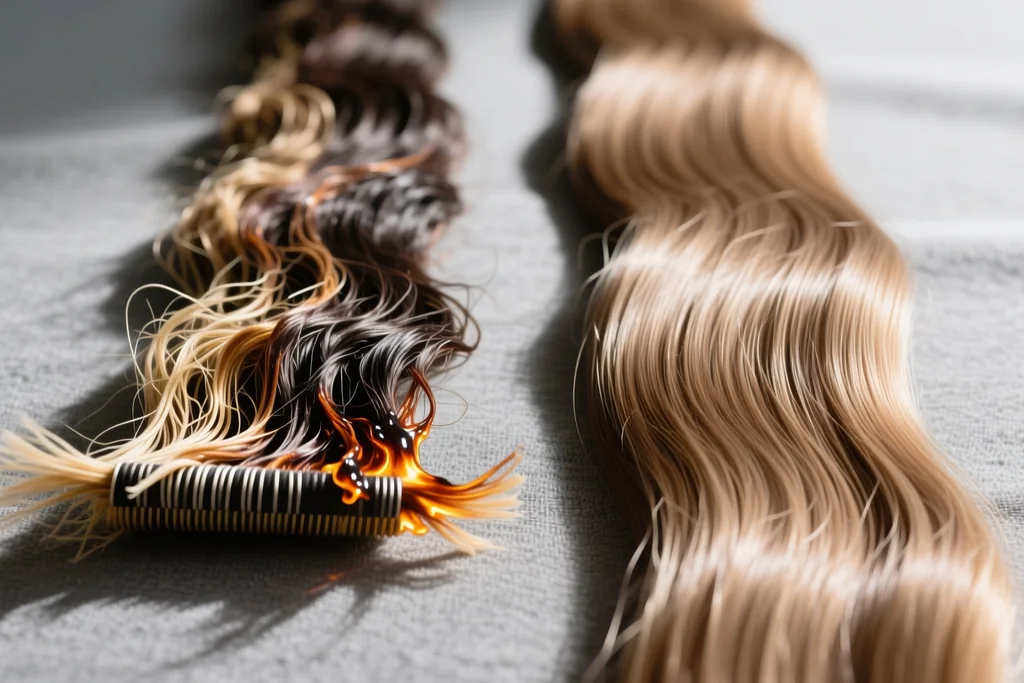
Extension hair, already compromised by processing, has less cuticle integrity to begin with. A flat iron pass at 230 degrees that natural hair might tolerate with minimal damage causes disproportionate harm to extension hair because the cuticle has less structural reserve. The result is extension hair that degrades faster than natural hair under the same heat exposure — and since extension hair cannot repair itself the way natural hair can (it receives no nutrients from the scalp), the damage is permanent and cumulative.
The color factor
If your extensions have been dyed or lightened, the heat tolerance drops further. Chemical processing breaks the disulfide bonds in the hair cortex, reducing the hair's structural integrity. Bleached extensions are the most vulnerable — they can tolerate a maximum of 160 degrees Celsius before the hair begins to physically degrade, and even at lower temperatures, the damage accumulates faster than on virgin hair.
Safe temperature ranges for different hair conditions
Not all extension hair responds to heat the same way, and setting your styling tool to a single temperature for every situation is a recipe for either under-styling or over-damaging. The correct temperature depends on the condition of the extension hair, the thickness of the strands, and the type of styling being done.
To calibrate your tools correctly, it helps to understand the safe temperature ranges for different extension hair conditions and what happens at each level.
Temperature safety varies significantly depending on whether the extension hair is virgin, processed, or bleached, and knowing the threshold for each condition prevents irreversible damage.
| Hair condition | Safe styling temp | Maximum temp (brief) | What happens above max | Recommended tools |
|---|---|---|---|---|
| Virgin extension hair (unprocessed) | 180–200°C | 200°C | Cuticle lifting, moisture loss, bond proximity risk | Flat iron, curling iron, hot brush |
| Processed extension hair (colored, not lightened) | 160–180°C | 180°C | Cuticle damage accelerates, color fades faster | Flat iron, curling iron with adjustable temp |
| Bleached or heavily lightened extensions | 140–160°C | 160°C | Structural damage, breakage, hair can snap | Low-temp tools only, heat-free styling preferred |
| Natural hair surrounding extensions | 180–220°C | 230°C | Normal heat damage range for natural hair | Any tool, with heat protectant |
| Tape-in bond area | Avoid direct heat | 0°C (no direct contact) | Adhesive softens, bond distorts, weft may slip | No tool should touch the bond |
The distinction between the bond area and the hair itself is the most critical takeaway from this comparison. The bond area must never receive direct heat from a styling tool after the initial application — not because the hair there is fragile, but because the adhesive is. A flat iron that accidentally clamps over a bond at 180 degrees will soften the adhesive, and the pressure of the plates will compress the softened bond into a distorted shape that no longer holds properly. This is the most common cause of premature bond failure in heat-styled extensions, and it happens in a fraction of a second.
Choosing the right heat styling tools
The tool you use matters as much as the temperature you set it to. Not all styling tools are suitable for extension hair, and some tools that work beautifully on natural hair create problems when used on extensions.
Flat irons: the most controllable option
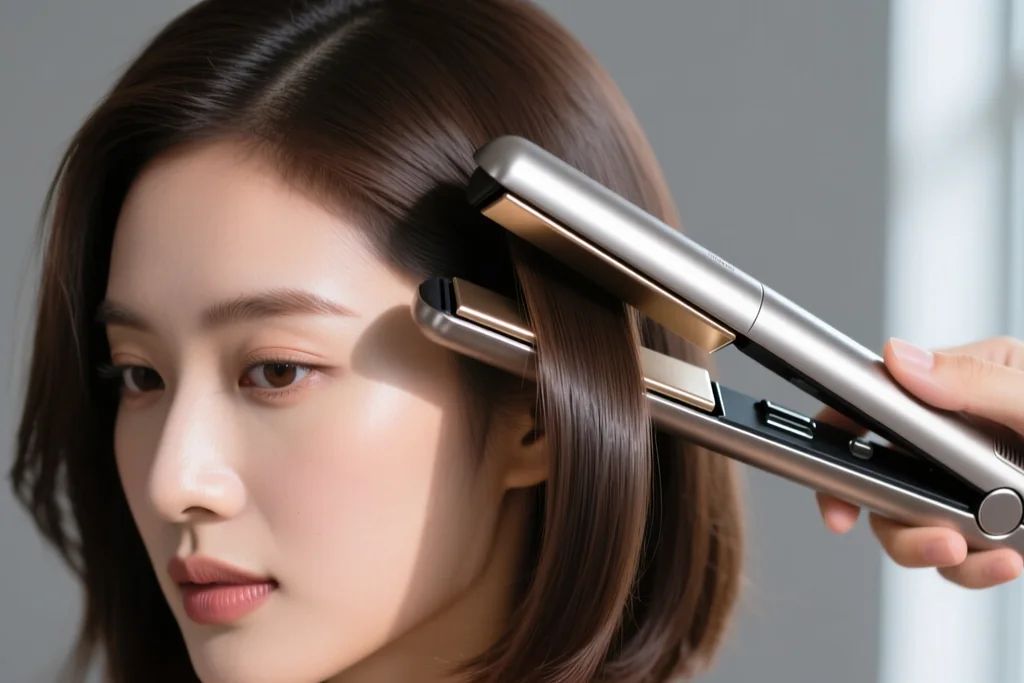
A flat iron with adjustable temperature is the most controllable heat styling tool for extensions because it allows precise heat setting and the plates can be kept away from the bond area. The ideal flat iron for extensions has ceramic or titanium plates, a digital temperature display (not a dial with vague settings like "low, medium, high"), and plates that are 1 to 1.25 inches wide — narrow enough to maneuver around the head without accidentally clamping bonds.
Titanium plates heat up faster and maintain temperature more consistently, but they transfer heat more aggressively to the hair. Ceramic plates heat more gently and distribute heat more evenly, making them the safer choice for extension hair that is already processed. Tourmaline-infused ceramic plates emit negative ions that reduce frizz and are the best option for extension hair, which tends to be drier than natural hair.
Curling irons and wands
Curling irons and wands are riskier for extensions than flat irons because the hair wraps around the barrel, and if the wrap extends too close to the root, the heat reaches the bond area. A curling wand with a clip is safer than a clipless wand because the clip provides a visual marker for where the hair starts, preventing the wrap from extending too close to the bond. Use a barrel diameter of 1 to 1.5 inches — larger barrels require fewer wraps, which means less of the hair is in contact with the heat at once.
Hot brushes and hot air brushes
Hot brushes are the gentlest heat styling option for extensions because they apply heat while simultaneously detangling, and the bristles create a buffer between the heating element and the hair. Hot air brushes — which combine a rotating barrel with a fan — are even gentler because the heat is distributed by air rather than direct contact. These tools are ideal for creating smooth, voluminous styles on extension hair without the concentrated heat of a flat iron or curling iron.
Tools to avoid
Steam-based tools and wet-to-dry flat irons should be avoided on extensions. Steam introduces moisture directly into the adhesive bond, which weakens the polymer. Wet-to-dry flat irons apply heat to wet hair, which causes the water in the cortex to boil and expand — a process called hygral fatigue that damages the cuticle far more than dry heat styling. Crimpers and deep-wave tools with textured plates create pressure points that can snag on the weft base and pull the extension hair away from the bond.
The heat protectant question: non-negotiable for extensions
Heat protectant is important for natural hair and non-negotiable for extension hair. A heat protectant creates a barrier between the cuticle and the heat source, reducing the temperature that reaches the cortex by 20 to 40 percent depending on the product. This temperature reduction is the difference between a flat iron at 180 degrees causing temporary cuticle lifting and causing permanent cuticle damage.
What to look for in a heat protectant for extensions
A heat protectant for extension hair must meet two criteria: it must provide thermal protection without containing ingredients that damage the adhesive bond. This means no oils (which dissolve acrylic adhesive), no heavy silicones (which build up and interfere with reapplication), and no alcohol-based formulas (which dry out extension hair). The ideal heat protectant for extensions is a water-based spray containing cyclomethicone or dimethicone copolyol (water-soluble silicones that provide heat protection without buildup) and glycerin (which attracts and retains moisture).
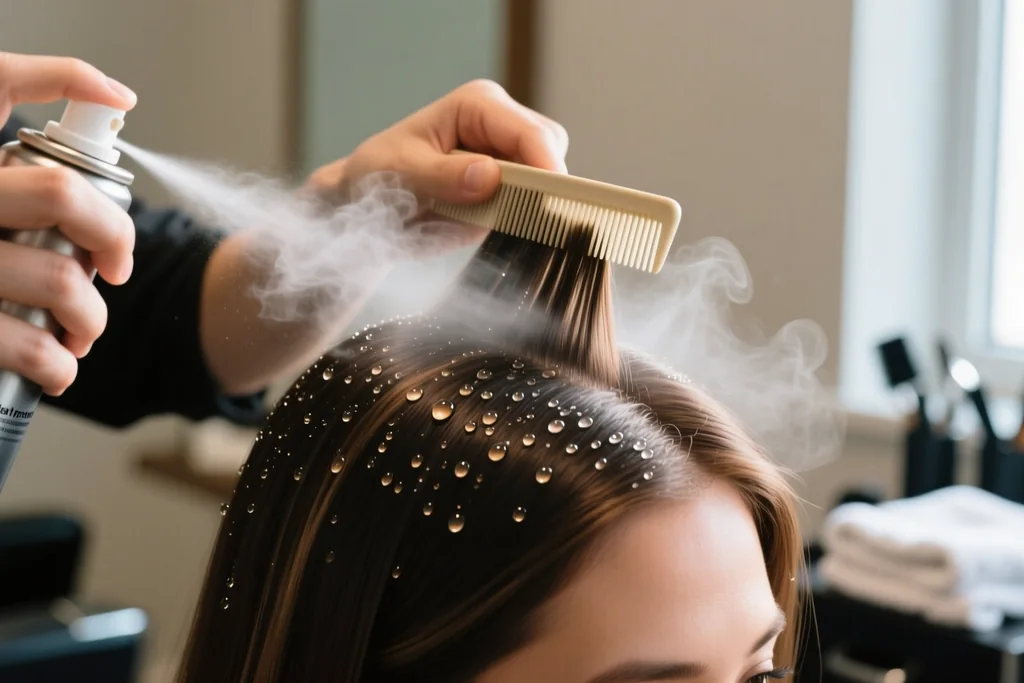
Apply heat protectant to the mid-lengths and ends of the hair only — never on or near the bond area. Spray from 8 to 10 inches away to create an even mist, and comb through with a wide-tooth comb to distribute the product evenly. Wait 30 seconds for the product to dry before applying heat — applying a flat iron to damp heat protectant creates steam that damages the cuticle and can reach the bond.
How heat protectant actually works
Heat protectants function through two mechanisms. First, they coat the cuticle with a thin film that slows heat transfer from the tool to the cortex, giving the hair more time to tolerate the heat before damage occurs. Second, they contain ingredients that absorb or disperse heat — silicones and certain polymers redirect heat energy away from the protein structure of the cortex. The protection is real but not unlimited: a heat protectant rated for 230 degrees reduces the effective temperature at the cortex by roughly 40 to 50 degrees, meaning a 180-degree flat iron feels like 130 to 140 degrees to the hair — a safe range for processed extension hair.
Technique: how to style without hitting the bonds
The right tool at the right temperature with the right protectant still causes damage if the technique is wrong. The physical act of passing a hot tool through extension hair requires a different approach than styling natural hair, because the bonds create a boundary that must be respected.
Before you start styling, it is important to understand the specific techniques that protect both the hair and the adhesive bonds from heat exposure.
Styling techniques that protect tape-in bonds and extension hair from heat damage:
- Keep all tools at least one inch below the bond — measure with your fingers: if you can feel the edge of the weft, start styling at least one finger-width below that point. Heat closer than one inch to the bond can soften the adhesive through conduction, even without direct contact.
- Style in sections, working from the bottom up — clip the top layers of hair away and style the bottom rows first. This prevents the tool from accidentally passing over a bond in the upper rows while you are focused on the lower sections.
- Use a fine-tooth comb to guide the tool — place the comb one inch below the bond and run it through the hair ahead of the flat iron or curling iron. The comb acts as a physical barrier that keeps the tool from drifting upward toward the bond.
- Never clamp a flat iron over the bond area — the pressure of the plates compresses the adhesive and the heat softens it simultaneously. Even at 180 degrees, clamping a bond for two seconds is enough to distort the adhesive and weaken the hold.
- Limit passes to two per section — one pass to style, one pass to refine. Multiple passes over the same section accumulate heat exposure that the cuticle cannot tolerate. If the style is not achieved in two passes, increase the section size slightly or re-evaluate the temperature.
- Let the hair cool before touching it — after styling a section, let it hang or pin it up without touching for 10 to 15 seconds. Touching hot hair with fingers or a brush deforms the shape before the hair has set, and the heat from your fingers adds a small but measurable amount of thermal stress.
- Style on dry hair only — never use heat tools on damp extension hair. Water in the cortex boils under heat, causing hygral fatigue that is far more damaging than dry heat styling. If the hair is even slightly damp from washing or a shower, dry it completely with a blow dryer on a cool setting before using any hot tool.
- Avoid heat styling daily — even with perfect technique and protectant, daily heat styling degrades extension hair faster than the hair can tolerate. Aim for 2 to 3 heat-styled days per week, and use heat-free methods — braiding, air-drying, rollers — on the remaining days.
These techniques form a system that protects both the extension hair and the bonds from the two mechanisms of heat damage: direct thermal degradation of the cuticle and indirect softening of the adhesive through conduction and proximity. The stylist who follows every one of these practices can heat-style extensions daily without significantly shortening the wear period; the one who ignores them will see bond failure and hair damage within two weeks.
Blow-drying: the heat source people forget
Flat irons and curling irons get the attention, but the blow dryer is the heat tool that most extension wearers use most frequently — and the one that causes the most overlooked damage. A blow dryer on high heat can reach 80 to 100 degrees Celsius at the nozzle, which is well below the adhesive threshold but high enough to damage extension hair if held too close or used on wet hair for too long.
Safe blow-drying technique for extensions
Blow-dry extension hair on a medium heat setting, holding the dryer 8 to 10 inches from the hair. Direct the airflow downward, from root to end, to smooth the cuticle rather than roughening it. Use a round brush with natural bristles — not metal — because metal-core brushes heat up under the dryer and create a secondary heat source that can scorch the hair.
The most important rule for blow-drying extensions is to dry the bond area first and completely. Moisture trapped in the bonds causes adhesive breakdown and odor, and the warm airflow from the dryer is the most efficient way to dry this area without direct heat. Hold the dryer 8 inches from the roots and move it continuously — do not hold it stationary over the bonds, as the sustained heat, even at a safe temperature, can begin to soften the adhesive over time.
For the mid-lengths and ends, use the dryer on a cool to medium setting and apply a heat protectant before drying — blow-drying is a heat styling process, and the cuticle needs protection from it as much as from a flat iron. Dry the hair to 80 percent and then let it air-dry the remaining 20 percent to minimize total heat exposure.
Heat-free styling alternatives
The most effective way to protect extension hair from heat damage is to not use heat. Heat-free styling methods can produce most of the looks that heat tools create, with zero thermal risk to the bonds and the hair. These methods take longer and require more planning, but for daily styling, they extend the life of the install by weeks.
Before reaching for a hot tool, consider the alternatives that can achieve similar results without any thermal risk to the bonds or extension hair.
Heat-free styling methods that work with tape-in extensions:
- Overnight braiding for waves — braid damp hair into one or two loose braids before bed and unravel in the morning for soft, natural waves. Use a silk scrunchie to secure the braid to prevent creasing and tangling.
- Velcro rollers for volume and curl — set dry hair in Velcro rollers at the crown and sides, leave for 30 to 60 minutes while getting ready, and remove for body and bounce without heat. The rollers grip the hair without clips, which means no pressure on the bonds.
- Flexi rods for defined curls — wrap damp hair sections around flexi rods before bed and remove in the morning for heat-free curls. The rods are lightweight and do not create tension at the bond area.
- Silk wrapping for smooth, straight hair — wrap damp hair flat against the scalp using a silk scarf and a stocking cap, leave overnight, and unwrap for smooth, straight hair with volume at the roots. This method is particularly effective for texture matching between natural hair and extensions.
- Air-drying with product for texture — apply a curl-defining cream to damp hair, scrunch gently, and let it air-dry for a natural texture that requires no heat and no manipulation. This method is the gentlest possible styling approach for extension hair.
- Pin curls for vintage waves — wrap dry hair sections around your fingers, pin flat against the head, and leave for 2 to 4 hours for smooth vintage waves. This method works best on hair that has been previously styled and is not freshly washed.
These methods produce results that rival heat styling for most everyday looks, and they do so without any risk to the adhesive bonds or the extension hair cuticle. The extension wearer who incorporates even two or three heat-free styling days per week significantly extends the life of both the bonds and the hair.
How to tell if heat has damaged your extensions
Heat damage to extensions is not always immediately visible, but it produces specific signs that a trained eye — or an informed wearer — can identify. Recognizing these signs early allows for changes in styling habits before the damage requires a full reapplication.
Signs of heat-damaged extension hair
The first sign is a change in texture. Extension hair that was smooth and silky when installed and becomes rough, dry, or stiff after a few weeks of heat styling has suffered cuticle damage. The change is most noticeable at the ends, which are the oldest and most exposed part of the hair and receive the most heat during styling. Compare the texture of the extension hair to the natural hair — if the natural hair feels smooth and the extension hair feels rough, the difference is heat damage, not normal wear.
The second sign is tangling. Healthy extension hair detangles easily with a loop brush and does not mat between washes. Heat-damaged extension hair develops tangles at the mid-lengths — where the flat iron passes most frequently — that require more force to detangle and reappear within a day of brushing. This tangling is caused by the raised cuticle scales catching on each other, and it is a sign that the cuticle is no longer smooth.
The third sign is loss of shine. Healthy extension hair reflects light evenly, creating a glossy appearance. Heat-damaged extension hair scatters light because the raised cuticle creates a rough surface, and the hair looks dull even after washing and conditioning. This dullness is permanent — no amount of oil or serum restores the shine of heat-damaged cuticle, because the damage is structural, not superficial.
Signs of heat-damaged bonds
The first sign of bond damage from heat is a change in the bond's physical feel. A healthy bond is flat, firm, and adhered to the hair with no lifting at the edges. A heat-damaged bond may feel slightly raised, soft, or tacky when you run your fingers along it. The adhesive has softened and re-hardened in a distorted shape, and the bond no longer has full contact with the hair.
The second sign is slipping. A bond that has been heat-damaged begins to slide down the hair shaft — away from the scalp and toward the ends. This movement is gradual and may not be noticeable until the weft is visibly lower than the surrounding wefts. Once a bond has slipped, it cannot be repositioned; the weft must be removed and reapplied with a new adhesive tab.
The third sign is adhesive residue on the natural hair. When heat softens the adhesive and the bond distorts, small amounts of adhesive can transfer from the tab to the natural hair surrounding the bond. This residue is sticky and attracts dirt and oil, creating a dark, visible patch around the weft that cannot be washed off with regular shampoo.
The cost of heat damage to extensions
Heat damage to extensions is not just a cosmetic issue — it has a direct financial cost that most wearers do not calculate until they are paying for a premature reapplication. A set of tape-in extensions that should last 8 weeks before reapplication, when heat-damaged, may need reapplication at 4 to 5 weeks. This halves the effective lifespan of each install and doubles the annual cost of extension maintenance.
For a set of extensions that costs $300 to $500, with reapplication adhesive tabs costing $30 to $50 per cycle, the annual cost of an 8-week wear cycle is approximately $650 to $1,050. If heat damage reduces the cycle to 5 weeks, the annual cost rises to $1,040 to $1,680 — a difference of $390 to $630 per year. This is the hidden cost of heat styling at the wrong temperature or without proper technique, and it does not include the cost of replacement wefts that become too damaged to reuse.
The daily decision: heat or health
Every morning, the extension wearer makes a choice: pick up the flat iron or pick up the flexi rods. The choice is not between looking good and looking bad — both methods can produce beautiful results. The choice is between immediate gratification and long-term value. The flat iron gives a polished, precise result in ten minutes. The overnight curls give a soft, natural result in zero minutes of active styling time. The flat iron takes 5 to 10 degrees off the lifespan of the extension hair and a fraction of a degree off the integrity of each bond it passes near. The overnight curls take nothing. Over eight weeks, the difference between the two choices — repeated daily — is the difference between extensions that look fresh at removal and extensions that look tired at week five. The heat is always available. The damage is always cumulative. And the decision is always yours, one morning at a time, for as long as you wear extensions.