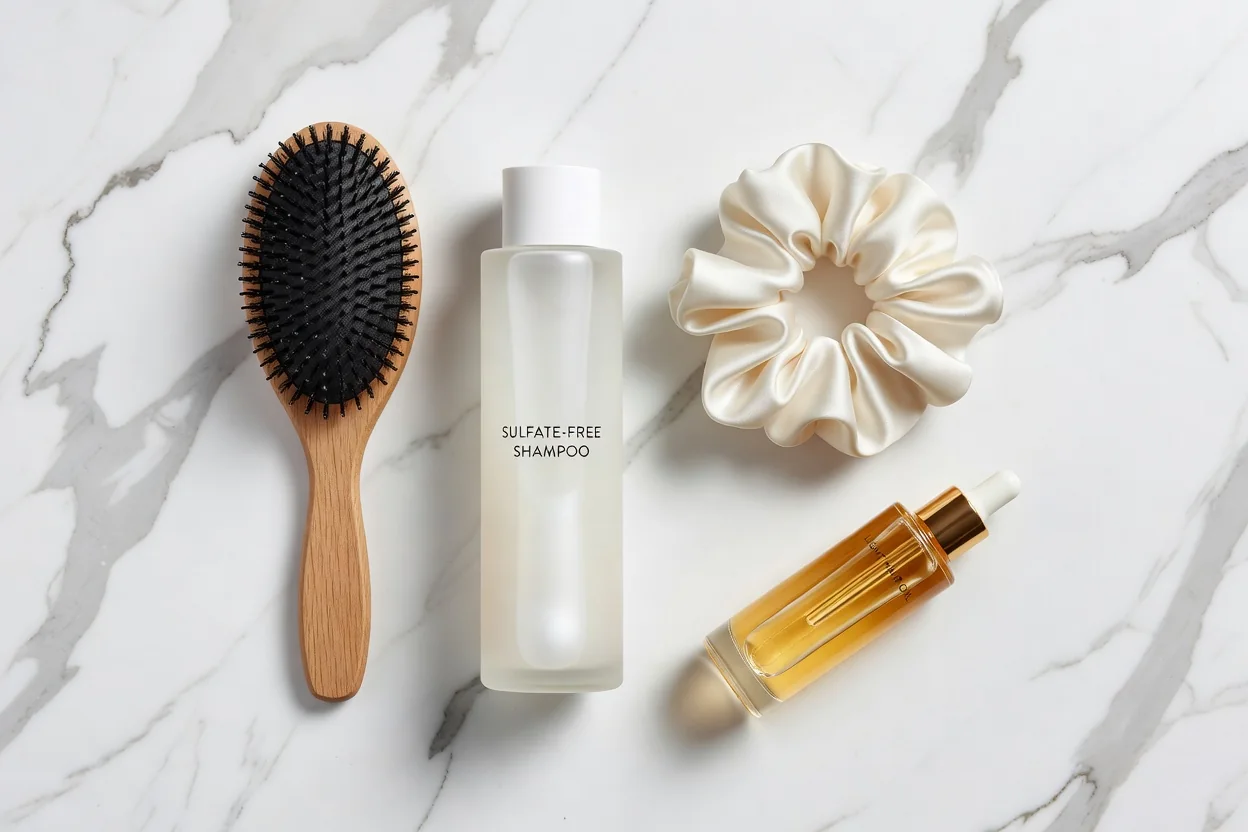
Sulfate-free shampoo for extensions: why and how to pick
The bottle says "sulfate-free" in large, confident letters, and you buy it because everyone tells you that sulfates are bad for extensions. You wash your hair, the shampoo barely lathers, your extensions feel clean but not squeaky, and three weeks later the bonds start slipping anyway. You check the ingredient list — and seventeen rows down, past the water and the glycerin and the herbal extracts that make the label look natural, sits sodium C14-16 olefin sulfonate. It is not called a sulfate, but it is an anionic surfactant that strips the hair and breaks down adhesive with the same enthusiasm as the sodium lauryl sulfate you were trying to avoid. The bottle did not lie — it is sulfate-free. But sulfate-free does not mean extension-safe, and the gap between those two terms is where most extension wearers lose weeks of wear time and dollars of investment to a product that was technically honest and practically misleading.
What sulfates actually do to extension bonds
Sulfates are surfactants — compounds that reduce the surface tension of water so that it can lift oil and dirt from the hair and scalp. In regular shampoo, the sulfate most commonly used is sodium lauryl sulfate (SLS) or sodium laureth sulfate (SLES). These are powerful, inexpensive, and effective at cleaning — which is why they are in everything from shampoo to dish soap to engine degreaser.
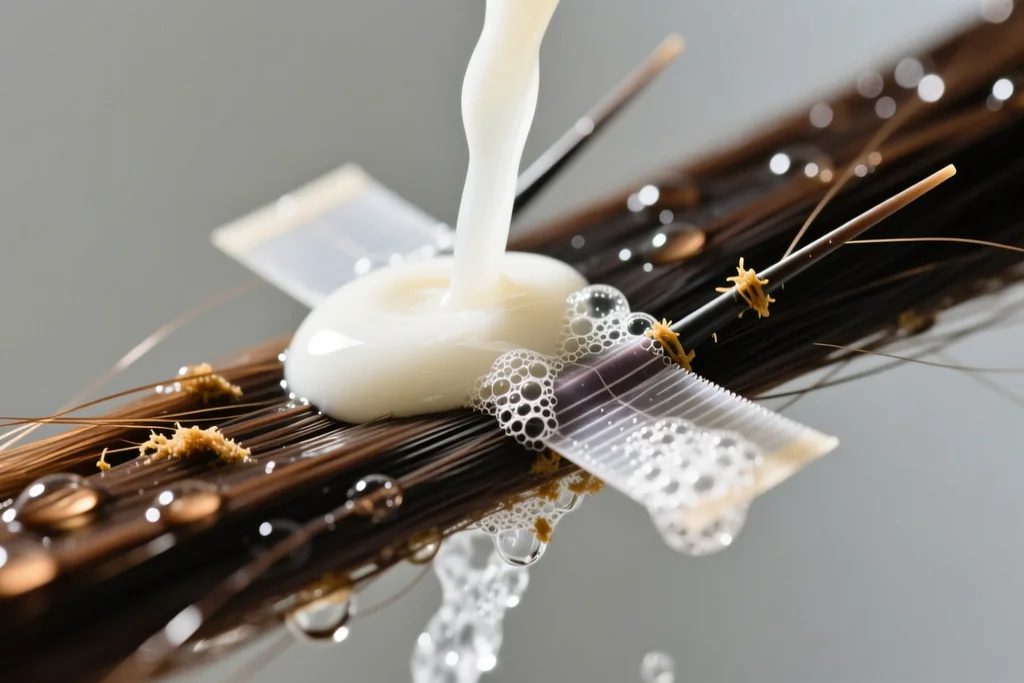
The cleaning power that makes sulfates effective is exactly what makes them destructive to extensions. Tape-in adhesive is an acrylic polymer that bonds to the hair cuticle through a combination of mechanical interlocking and surface adhesion. Sulfates disrupt this bond in two ways. First, they strip the natural oils from the hair shaft, including the oils that help the adhesive maintain flexibility and grip. A bond that loses its surrounding moisture and oil becomes brittle and prone to lifting at the edges. Second, sulfates are small enough to penetrate the polymer matrix of the adhesive, where they break the molecular chains that give the bond its strength. This degradation is not instant — it happens over multiple washes, with each wash removing a microscopic layer of adhesive integrity until the bond can no longer hold.
The effect is cumulative and silent. You do not see the bond weakening after the first wash or the third. You notice it at wash number eight, when a weft slides out during rinsing — and by then, the damage to the remaining bonds is already advanced. This is why sulfate-free shampoo is not a luxury for extension wearers; it is the single most important factor in how long an install lasts.
Beyond sulfates: other ingredients that damage extensions
Sulfates are the most well-known culprit, but they are not the only ingredient in shampoo that compromises extension bonds. A shampoo can be genuinely sulfate-free and still destroy your install through other components that interact with adhesive, hair cuticle, or both.
Alcohol and alcohol derivatives
Certain alcohols are drying and stripping — specifically, short-chain alcohols like isopropyl alcohol, ethanol, and SD alcohol. These evaporate quickly and take moisture with them, leaving the hair shaft dry and the adhesive brittle. Not all alcohols are harmful — cetearyl alcohol, stearyl alcohol, and cetyl alcohol are fatty alcohols that moisturize and condition. The distinction matters: a shampoo that lists cetearyl alcohol is fine; one that lists isopropyl alcohol near the top of the ingredient list is not.
Silicones that build up
Silicones coat the hair shaft in a thin film that creates shine and smoothness — desirable for extension hair, which tends to dry out. But non-water-soluble silicones (dimethicone, cyclomethicone, amodimethicone) build up on the hair over multiple washes, creating a layer that prevents new adhesive from bonding during reapplication and weighs down fine extension hair. Water-soluble silicones (PEG-silicones) do not build up but are less common in drugstore products.
Oils in shampoo
Oils are the enemy of acrylic adhesive. A shampoo that contains argan oil, coconut oil, or jojoba oil — even in small amounts — deposits a film on the hair that weakens the adhesive bond with each wash. Oil-infused shampoos are marketed as nourishing, and they are — for natural hair. For extension bonds, they are a slow-acting solvent.
Proteins and amino acids
Protein is good for hair strength, but excessive protein from daily shampoo can make extension hair brittle. Extension hair — especially Remy hair that has been processed — needs moisture more than protein. A shampoo that lists hydrolyzed keratin as the third or fourth ingredient may be too protein-heavy for regular use on extensions.
Reading labels: what sulfate-free actually guarantees
The term "sulfate-free" is not regulated with the precision that consumers assume. A product can claim to be sulfate-free while containing surfactants that are chemically distinct from sulfates but function identically — stripping oil, disrupting adhesive, and degrading the hair cuticle. Understanding what the label guarantees — and what it does not — is the difference between choosing a shampoo that protects your investment and choosing one that wears the right label while doing the wrong thing.
To make informed decisions when reading shampoo labels, it helps to understand the most common sulfates, their relatives, and the level of risk each one poses to extension bonds.
Different surfactants affect extension bonds differently, and knowing which ones to avoid — and which are safe — allows you to read a label with confidence rather than hope.
| Surfactant / ingredient | Type | Found in | Effect on extension bonds | Risk level | Verdict |
|---|---|---|---|---|---|
| Sodium lauryl sulfate (SLS) | Sulfate | Drugstore shampoo, body wash | Strips oil, penetrates adhesive, breaks polymer chains | Very high | Avoid completely |
| Sodium laureth sulfate (SLES) | Sulfate | Most commercial shampoo | Milder than SLS but still degrades adhesive over repeated washes | High | Avoid |
| Ammonium lauryl sulfate (ALS) | Sulfate | Clarifying shampoo, deep-clean formulas | Very aggressive; fastest adhesive breakdown | Very high | Avoid completely |
| Sodium C14-16 olefin sulfonate | Non-sulfate surfactant | "Sulfate-free" shampoo | Strips oil similarly to SLS; degrades adhesive | High | Avoid despite sulfate-free label |
| Cocamidopropyl betaine | Mild surfactant | Gentle shampoo, baby shampoo | Mild cleaning; minimal adhesive impact at normal wash frequency | Low | Acceptable |
| Sodium cocoyl isethionate | Mild surfactant | Premium sulfate-free shampoo | Gentle cleansing; low adhesive impact | Low | Good choice |
| Decyl glucoside | Non-ionic surfactant | Natural shampoo, sensitive-skin formulas | Very gentle; minimal adhesive impact | Very low | Excellent choice |
| Lauryl glucoside | Non-ionic surfactant | Natural shampoo | Gentle, non-stripping | Very low | Excellent choice |
| Sodium cocoyl glutamate | Amino-acid surfactant | Premium gentle shampoo | Very mild; conditions while cleansing | Very low | Excellent choice |
The pattern in this comparison is clear: the risk comes not from the word "sulfate" but from the chemical behavior of the surfactant. Anionic surfactants that are small molecules with strong oil-stripping capacity — whether called sulfates or not — damage extension bonds. Larger, milder surfactants that cleanse without aggressive oil removal are safe for extensions, regardless of whether they carry the sulfate-free label. Reading the ingredient list for specific surfactant names, not just for the absence of the word "sulfate," is the skill that separates a protected install from a prematurely failed one.
The ingredients that replace sulfates
Sulfate-free shampoos clean hair using alternative surfactants that are gentler on the cuticle and less disruptive to adhesive bonds. These alternatives fall into three categories, and understanding them helps you evaluate a shampoo beyond the marketing label.
Glucosides: the gentlest option
Glucosides are non-ionic surfactants derived from glucose and fatty alcohols. Decyl glucoside and lauryl glucoside are the most common in extension-safe shampoos. They produce a light, airy lather that cleanses without stripping, and they have minimal impact on acrylic adhesive. Shampoos based on glucosides are the safest choice for extension wearers, but they are also the most expensive because glucosides cost more to manufacture than sulfates or sulfonates.
Amino-acid surfactants: the premium tier
Sodium cocoyl glutamate, sodium lauroyl sarcosinate, and disodium cocoyl glutamate are surfactants derived from amino acids. They are exceptionally gentle, produce a moderate lather, and actually condition the hair while cleansing. Shampoos using amino-acid surfactants are ideal for extensions because they maintain the moisture balance that keeps adhesive bonds flexible and the hair cuticle smooth. They are found primarily in salon-grade and premium shampoos.
Betaines: the middle ground
Cocamidopropyl betaine is a mild amphoteric surfactant used in many mid-range sulfate-free shampoos. It produces a richer lather than glucosides and cleanses more effectively on oily hair, with minimal adhesive impact. Betaines are a good compromise for extension wearers who need more cleansing power than glucosides provide but want to avoid the harshness of sulfonates.
How to identify a genuinely extension-safe shampoo
Knowing the ingredient names is half the battle; the other half is knowing how to evaluate a shampoo when you are standing in the store aisle with a phone in one hand and a bottle in the other. The process of selecting an extension-safe shampoo involves checking specific criteria in a specific order.
Before you put a shampoo bottle in your cart, run it through a checklist that separates genuinely extension-safe formulas from those that are merely sulfate-free in name.
Checklist for choosing an extension-safe sulfate-free shampoo:
- Check the first five ingredients — the first five ingredients make up 80 to 90 percent of the formula. If any of them is a sulfate or sulfonate (SLS, SLES, ALS, olefin sulfonate), the product is not extension-safe regardless of the label claim.
- Look for glucosides or amino-acid surfactants — decyl glucoside, lauryl glucoside, sodium cocoyl glutamate, or sodium lauroyl sarcosinate in the first five ingredients indicates a genuinely gentle formula.
- Verify there are no oils in the formula — scan the full ingredient list for argan oil, coconut oil, jojoba oil, olive oil, or any essential oil. Even trace amounts weaken adhesive bonds over repeated washes.
- Check for non-water-soluble silicones — dimethicone, cyclomethicone, and amodimethicone build up on the hair and interfere with reapplication. Water-soluble silicones (PEG-dimethicone) are acceptable.
- Avoid protein-heavy formulas — one protein ingredient (hydrolyzed keratin, silk protein) is fine; three or four protein ingredients indicate a protein-focused shampoo that can make extension hair brittle.
- Confirm pH balance — the ideal pH for extension hair is 4.5 to 5.5, slightly acidic to keep the cuticle closed. Shampoos that state "pH-balanced" on the label are preferable; highly alkaline shampoos swell the cuticle and roughen extension hair.
- Avoid fragrance-heavy formulas if the scalp is sensitive — extension wear creates more scalp contact time with shampoo residue, and strong fragrances can cause irritation under the wefts where rinsing is less thorough.
This checklist takes two minutes to run through and eliminates the vast majority of shampoos that would damage extensions. The shampoo that passes all seven criteria is genuinely extension-safe — not just sulfate-free, but formulated in a way that preserves adhesive bonds, maintains hair moisture, and does not interfere with reapplication.
How wash technique matters as much as the shampoo
Even the best sulfate-free shampoo damages extensions if used incorrectly. The application technique determines how much contact the shampoo has with the bonds, how much residue remains, and how much mechanical stress the hair endures during washing. A mediocre sulfate-free shampoo with excellent technique outperforms a premium shampoo with poor technique.
The wash routine for extension hair differs from natural hair washing in three key areas: where the shampoo is applied, how it is distributed, and how it is rinsed. Shampoo should be applied to the scalp and roots only — not to the extension wefts or the mid-lengths. The natural oils from the scalp travel down the hair shaft during the wash, cleansing the extension hair without direct application. Scrubbing shampoo into the wefts or the bond area accelerates adhesive breakdown and tangles the hair at the bond point.
Distribution should be gentle — use the pads of the fingers, not the nails, and move in downward strokes, never in circular motions. Circular motions create tangles at the bond point that are difficult to remove without pulling. Rinsing should be thorough — twice as long as feels necessary — because shampoo residue trapped in the bonds is a primary cause of adhesive degradation and odor. Rinse with warm water, not hot, and finish with a cool rinse to seal the cuticle.
The transition period: what to expect when switching
Switching from a sulfate shampoo to a sulfate-free formula produces a transition period that confuses many first-time extension wearers. The hair feels different — less squeaky, less stripped, and sometimes slightly different in texture. This is normal and temporary, but understanding what to expect prevents the common mistake of abandoning sulfate-free shampoo after one or two washes.
Sulfate shampoos strip the hair so completely that the hair feels "squeaky clean" — a sensation that many people associate with cleanliness but that actually indicates over-stripping. Sulfate-free shampoos clean without stripping, so the hair feels clean but not squeaky. The first two to three washes with a sulfate-free formula may feel like the shampoo is not working, because the hair retains its natural oils and does not produce the stripped sensation that years of sulfate use have conditioned the wearer to expect.
The transition typically lasts 2 to 3 weeks, during which the scalp adjusts its oil production. Sulfate shampoos trigger overproduction of oil because the scalp compensates for being stripped, which is why hair gets oily faster with sulfate shampoo. Sulfate-free formulas allow the scalp to find its natural balance, and after the transition, the hair stays clean longer between washes. For extension wearers, this adjustment period is an investment in bond longevity — every additional day between washes is a day less of adhesive exposure to water and surfactant.
Signs your current shampoo is damaging your extensions
Not every extension problem traces to shampoo, but certain symptoms point directly to shampoo-related damage. Recognizing these signs early allows you to switch formulas before the damage requires a full reinstallation.
Before changing your shampoo or assuming the problem lies elsewhere, check for these specific indicators that your current formula is compromising your extension bonds.
Warning signs that your shampoo is damaging extensions:
- Bonds lifting at the edges within 2 weeks of application — if the adhesive tabs begin to peel at the edges before the expected 6-week mark, the shampoo is likely breaking down the polymer. Check the ingredient list for sulfates, sulfonates, or oils.
- Extension hair feeling dry and rough after washing — this indicates that the shampoo is stripping the hair cuticle, which also means it is stripping the adhesive. Switch to a gentler formula immediately.
- Scalp feeling tight and itchy after washing — a tight, itchy scalp is a sign of over-stripping. The shampoo is removing too much natural oil, which affects both the scalp and the adhesive bonds.
- Bonds becoming gummy or tacky to the touch — if the adhesive feels soft or sticky when you run your fingers along the bond, the polymer is breaking down. This is a direct sign of chemical degradation, typically from sulfates or oils in the shampoo.
- Wefts slipping during rinsing — a weft that slides during rinsing has lost its bond integrity. If this happens with multiple wefts, the shampoo is the likely cause, and continuing to use it will result in progressive bond failure across the entire install.
- Extension hair tangling more than usual at the bond point — excessive tangling at the bond indicates that the adhesive has degraded and is no longer holding the hair flat. The degraded adhesive creates a rough surface that catches surrounding hair.
- Visible residue or cloudiness on the adhesive tabs — shampoo residue that does not rinse completely leaves a film on the adhesive that weakens the bond over time. This is more common with thick, creamy sulfate-free formulas that are not rinsed thoroughly.
- Hair getting oily faster after switching to sulfate-free — this is not damage but a transition sign. The scalp is adjusting to the new formula and will normalize within 2 to 3 weeks. Do not switch back to sulfate shampoo during this period.
Any of the first seven signs warrants an immediate shampoo change. The eighth — increased oiliness — is a normal transition symptom that resolves on its own if the new formula is given time to work.
Budget vs premium: does price predict extension safety
The shampoo market offers sulfate-free options at every price point, from $4 drugstore bottles to $40 salon formulas. The question for extension wearers is whether the price difference correlates with extension safety — and the answer is both yes and no, depending on which ingredients you are paying for.
Budget sulfate-free shampoos (under $10) typically use cocamidopropyl betaine or sodium C14-16 olefin sulfonate as the primary surfactant. Betaine is extension-safe; olefin sulfonate is not. The difference between a $6 shampoo that is safe and one that is not comes down to which surfactant the manufacturer chose — and budget brands do not always disclose this clearly. A budget shampoo that uses betaine or glucoside is fine for extensions; one that uses sulfonate is not, despite the sulfate-free label.
Mid-range sulfate-free shampoos ($10 to $25) are more likely to use glucoside or amino-acid surfactants, which are genuinely gentle. They also tend to avoid oils and heavy silicones, making them better suited for extension maintenance. The price increase over budget options reflects the higher cost of gentler surfactants and more thoughtful formulation.
Premium sulfate-free shampoos ($25 and above) use the highest-quality surfactants — amino-acid derivatives, lipid-based cleansers — and are formulated specifically for processed or chemically treated hair, which includes extension hair. They provide the best combination of gentle cleansing, moisture retention, and adhesive preservation. Whether the premium price is justified depends on the value of the extensions being protected: a $40 shampoo that extends the life of a $400 set of extensions by 2 to 3 weeks per cycle is a rational investment.
The rule is not that expensive is better — it is that the ingredient list is the only reliable predictor. A $8 shampoo with decyl glucoside as the second ingredient is better for extensions than a $35 shampoo with sodium C14-16 olefin sulfonate as the third ingredient. Price is a hint, not a guarantee; the label is the proof.
How often to wash extensions with sulfate-free shampoo
Even with the correct shampoo, wash frequency affects bond longevity. Each wash — regardless of how gentle the formula — exposes the adhesive to water, surfactant, and mechanical manipulation. Reducing wash frequency is as important as choosing the right formula.
The ideal wash frequency for extension hair is every 2 to 3 days, with a maximum of 4 days between washes for normal activity levels. Washing daily, even with the gentlest sulfate-free shampoo, exposes the bonds to more water and surfactant contact than the adhesive is designed to withstand over 6 to 8 weeks. Between washes, dry shampoo can be used at the roots — not on the wefts or bonds — to absorb oil and extend the interval.
For active individuals who sweat heavily or swim, washing may need to be more frequent. In these cases, choosing the gentlest possible sulfate-free formula becomes even more critical, and the wear period should be shortened to 5 to 6 weeks instead of 6 to 8, because the increased wash frequency accelerates bond degradation.
The one product that determines whether your install lasts
Shampoo is the product that touches your extensions more frequently and more intimately than any other — more than the brush, more than the heat protectant, more than the sleeping routine. Every wash is a chemical event that either preserves the adhesive bond or degrades it, and the outcome of that event is determined by the surfactants in the bottle you reach for. The extension wearer who understands that "sulfate-free" is a starting point, not a finish line — who reads the ingredient list for the specific surfactants that matter, who washes with technique as careful as the formula is gentle, and who gives the transition period the patience it requires — is the wearer whose extensions last 8 weeks instead of 4 and whose wefts survive 3 reapplication cycles instead of 1. The shampoo is not a detail in extension maintenance. It is the foundation, and every other maintenance practice — brushing, sleeping, styling — is built on top of it. Choose the foundation correctly, and everything above it holds. Choose it wrong, and no amount of careful brushing or gentle sleeping can compensate for the slow, invisible damage that happens in the shower every two days.