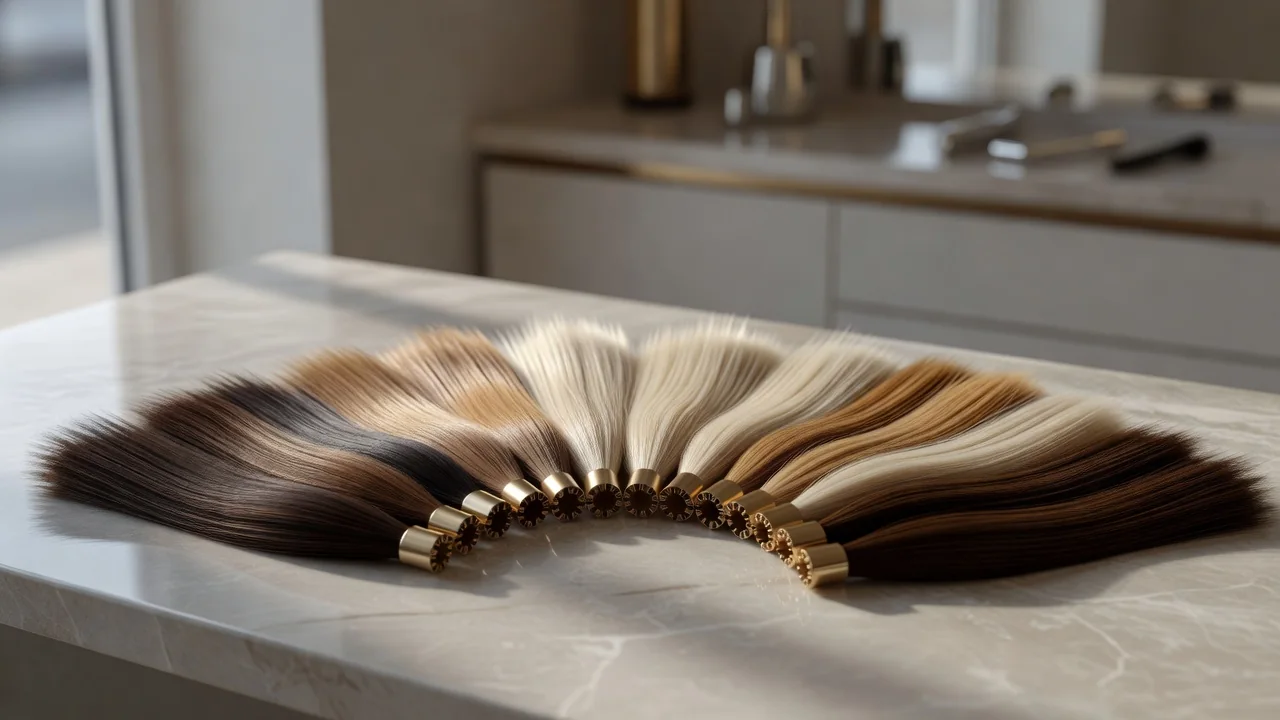
Fine hair extensions: choose weight, method, placement
Fine hair is not thin hair — and the distinction matters more in extension selection than anywhere else in hair care. Fine hair refers to the diameter of each individual strand, which can be small even when the overall density is normal. A person with fine hair can have a full head of it and still struggle with extensions that look bulky, bonds that show through, and roots that ache after two days of wear because the weight of the wefts pulls on follicles that are not structurally equipped to carry the load. The extension industry is built around the assumption of medium to thick hair — most wefts are too heavy, most bonds are too large, and most placement patterns assume enough natural hair to hide everything underneath. For fine hair, every one of these defaults is wrong, and following standard advice leads to the three outcomes that fine-haired people know all too well: visible bonds, traction discomfort, and breakage that leaves the hair thinner after extensions than before. The solution is not to avoid extensions — it is to choose them with a level of specificity that the industry does not advertise, because the products designed for fine hair are the same products that everyone else uses, just fewer, lighter, and placed differently.
Why fine hair reacts differently to extensions
The physics of fine hair and extensions is simple and unforgiving. Each hair follicle can support a certain amount of weight before the tension causes the follicle to shift, inflame, or release the hair entirely. In coarse or medium hair, the follicle is anchored to a larger, more robust root structure, and the strand itself has greater tensile strength — it can bear the weight of an extension weft without strain. In fine hair, the follicle is smaller, the root is less deeply anchored, and the strand has lower tensile strength. A weft that a medium-haired person wears without noticing creates measurable tension on fine-hair follicles — tension that accumulates over hours and days.
This tension manifests as scalp soreness in the first 24 to 48 hours after application, which is normal for any extension install. But in fine hair, the soreness can persist beyond the adjustment period and progress to traction — a pulling force that, over weeks, causes follicles to release hairs prematurely and, in severe cases, to stop producing new hair. Traction alopecia from extensions is not a rare condition; it is the most common form of extension-related damage, and fine hair is the most susceptible because the follicles have the least structural margin.
Fine hair also poses a visibility problem. The same thinness that makes the hair look flat and lacking in volume means there is less natural hair to cover each extension bond. A tape-in weft that is invisible under a layer of thick hair is easily spotted through fine hair, particularly at the temples, the crown, and along the part line. The extension industry addresses this with "seamless" wefts and smaller bonds, but the fundamental issue remains: fine hair does not hide things well, and every placement decision must account for this limitation.
The weight question: how many grams is too many
The weight of extensions is measured in grams per weft or grams per set, and it is the single most important variable for fine hair. Most extension sets sold for full-head application contain 100 to 200 grams of hair, distributed across 20 to 40 wefts. For medium to thick hair, this weight is appropriate and produces a natural-looking result. For fine hair, this weight is excessive and creates the tension and visibility problems that lead to damage.
The weight that fine hair can comfortably support depends on the natural density — the number of hairs per square centimeter of scalp — and the condition of the follicles. A person with fine but dense hair can support more weight than a person with fine and sparse hair. As a general guideline, fine hair should not carry more than 60 to 120 grams of extension hair for a full-head application, distributed across wefts that are individually lightweight.
The weight per weft matters more than the total weight. A 100-gram set distributed across 40 wefts averages 2.5 grams per weft — manageable for fine hair. The same 100 grams distributed across 20 wefts averages 5 grams per weft — too heavy per bond for fine hair follicles. The number of wefts, not just the total weight, determines the load on each individual follicle group.
Extension methods compared for fine hair
Each extension method interacts with fine hair differently, and the choice of method is as important as the choice of weight. Some methods are inherently better suited to fine hair because they distribute weight more evenly, use smaller bonds, or allow for more flexible placement.
Tape-in extensions: the default choice for fine hair
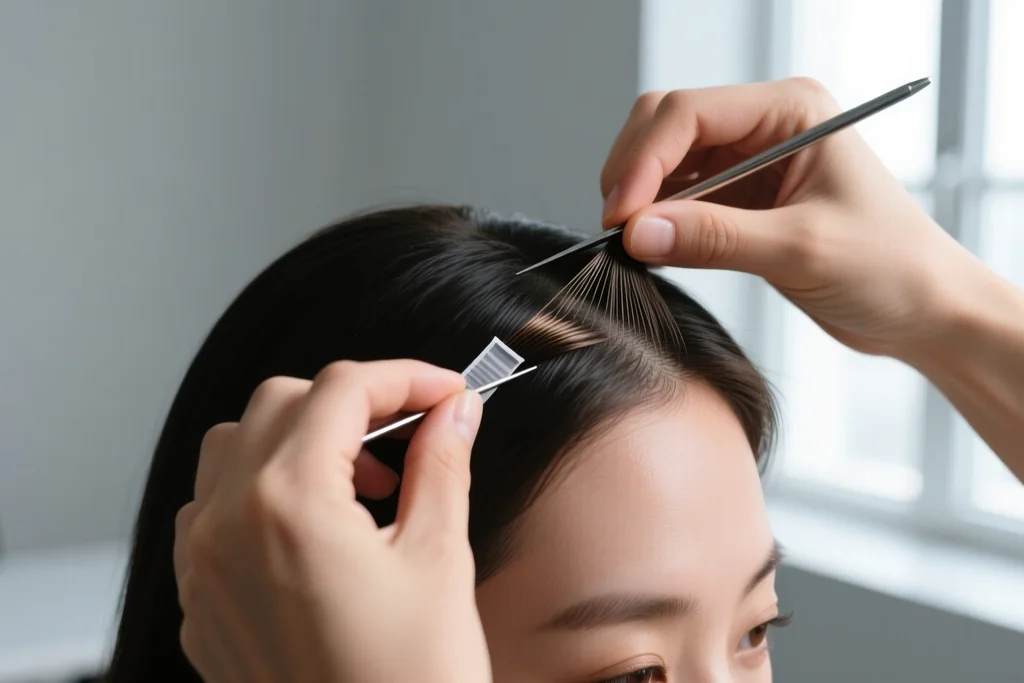
Tape-in extensions are the most commonly recommended method for fine hair, and for good reason. The adhesive strip distributes weight across a wide area — 1.5 inches of bond — rather than concentrating it at a single point, as a fusion bond or micro-link does. This distribution reduces the load per follicle and minimizes traction. The wefts lie flat against the head, creating a low profile that is less visible under fine hair than bulkier methods.
For fine hair, tape-ins work best with modifications to the standard application. Mini wefts (0.5 to 0.75 inches wide) should be used instead of standard wefts in areas where coverage is thin — temples, hairline, crown. The total number of wefts should be reduced: 15 to 25 wefts for a full head of fine hair, compared to 30 to 40 for medium hair. The placement should avoid areas where the hair is sparsest, and the rows should be spaced farther apart to ensure adequate natural hair coverage between them.
The limitation of tape-ins for fine hair is the sandwich application method. The natural hair is placed between two adhesive wefts, and if the section of natural hair is too thin, the two adhesive strips can contact each other at the edges, creating a rigid, bulky bond that is visible and uncomfortable. For very fine or sparse hair, single-sided application — where only one weft is used per section, with the adhesive facing the natural hair — may be more appropriate, though the bond is less secure.
Micro-link (i-tip) extensions: precise but risky
Micro-link extensions use small metal cylinders to clamp individual strands of extension hair to natural hair. Each link is tiny — 2 to 3 millimeters — and theoretically invisible. The advantage for fine hair is precision: each strand is placed individually, allowing the applicator to avoid sparse areas and concentrate density where the natural hair is thickest.
The disadvantage is weight concentration. Each micro-link holds the weight of one extension strand on a small number of natural hairs — typically 3 to 5 strands. In fine hair, 3 to 5 natural strands are not enough to support the weight of an extension strand without tension, and over weeks, the links pull on these few strands, causing breakage and traction. Micro-links are suitable for fine hair only if the extension hair is lightweight (0.5 to 0.7 grams per strand, compared to the standard 0.8 to 1 gram) and if the links are placed only in areas with adequate natural density.
Fusion (keratin bond) extensions: not recommended for fine hair
Fusion extensions use keratin-tipped extension strands that are melted onto natural hair with a heated tool. Each bond is 3 to 5 millimeters in diameter and hard. For fine hair, fusion bonds are problematic for three reasons: the bonds are bulky and visible through fine hair, the weight is concentrated at a single point per strand, and the heat used to melt the keratin can damage fine hair, which is more heat-sensitive than coarse hair.
Fusion extensions should be avoided for fine hair unless applied by a highly skilled professional who uses micro-bonds (1 to 2 millimeter bonds), lightweight strands (0.5 grams), and places them exclusively in dense areas. Even then, the risk of visibility and traction is higher than with tape-ins.
Clip-in extensions: the safest option for occasional wear
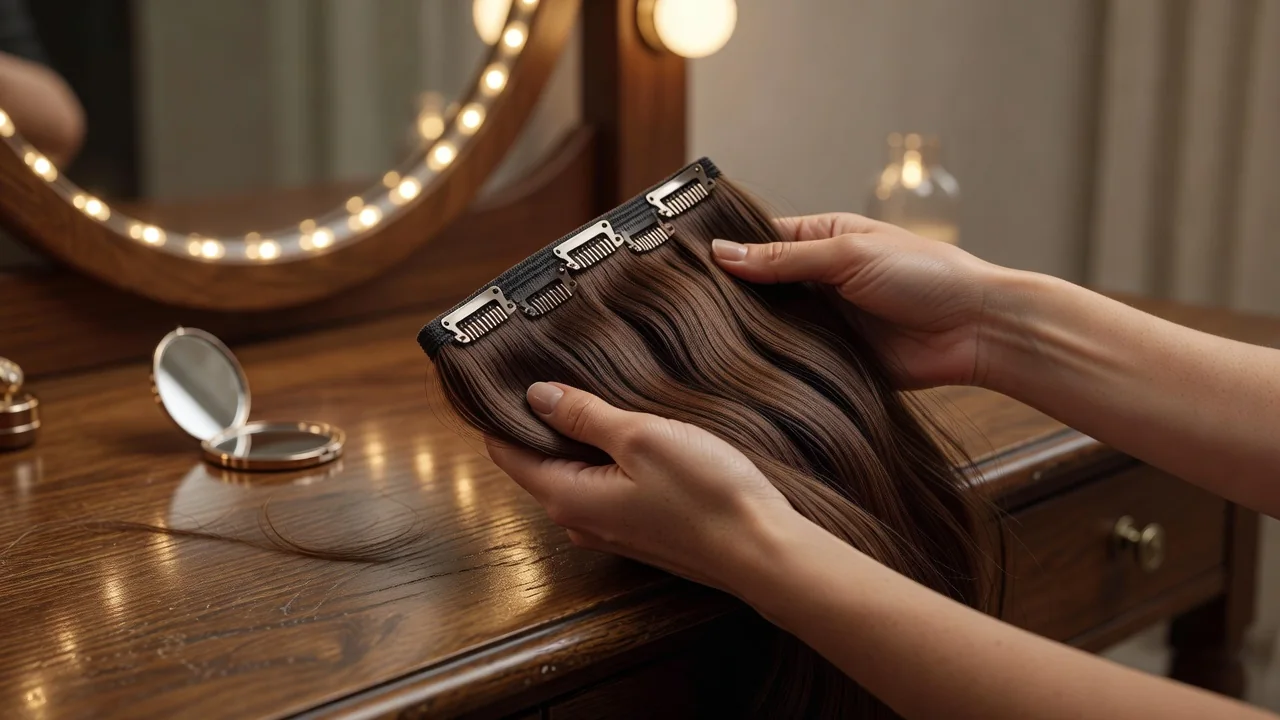
Clip-in extensions are temporary — they are applied in the morning and removed at night. Because they are not worn continuously, they do not create sustained traction on the follicles. For fine hair, clip-ins are the safest option for occasional volume and length, provided they are lightweight and placed correctly.
The risk with clip-ins for fine hair is that the clips can slip, because fine hair does not provide enough grip for the clip teeth to hold. Using clips with silicone-backed grips prevents slipping without adding weight. The wefts should be lightweight (60 to 100 grams total for a full set), and the clips should be sewn close together to distribute weight evenly across the weft.
Sewn-in (weave) extensions: not recommended
Sewn-in extensions involve braiding the natural hair into cornrows and sewing wefts of extension hair onto the braids. The weight of the wefts is distributed along the braid, but the tension on the natural hair is high — the braids are tight, and the sewn wefts add sustained pulling force. For fine hair, the tension from braiding alone can cause traction, and the weight of the wefts compounds the problem. Sewn-in extensions are not recommended for fine hair under any circumstances.
Placement principles specific to fine hair
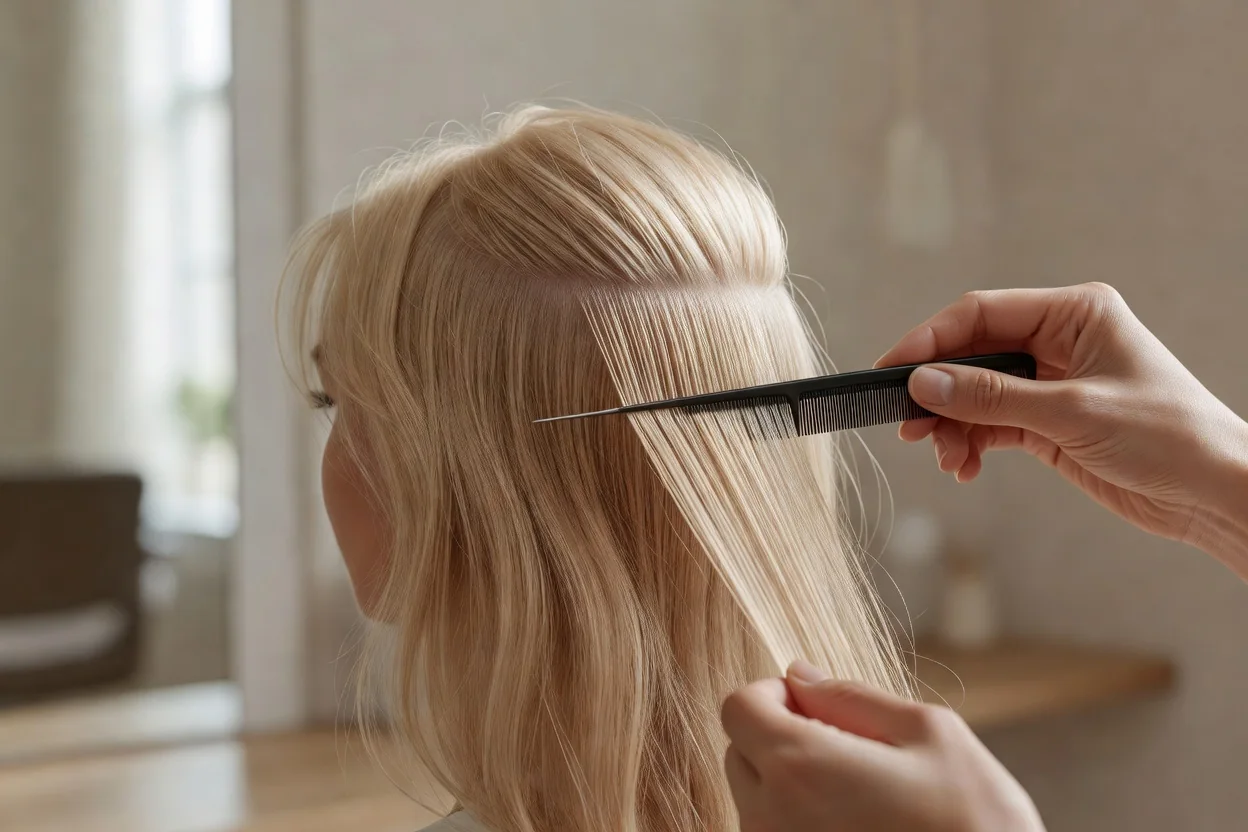
Placement — where each weft or bond is positioned on the head — is the variable that most determines whether extensions are visible and whether they cause damage in fine hair. Standard placement patterns assume that natural hair will cover the bonds; fine hair cannot always be relied on to do this, and the placement must be adapted.
The one-inch rule
No extension bond or weft should be placed within one inch of the hairline, the part line, or the crown's highest visible point. In fine hair, this rule is not a guideline — it is a hard boundary. Wefts placed closer than one inch to any visible edge will show when the hair moves, when the wind blows, or when the hair is pulled up. The natural hair in front of and above each weft must be thick enough to cover the bond completely, and in fine hair, this requires more natural hair per weft than in thick hair.
Row spacing
In standard applications, rows of wefts are spaced one inch apart. In fine hair, rows should be spaced 1.5 to 2 inches apart to ensure that each row has adequate natural hair above it for coverage. This means fewer rows — typically 3 to 4 instead of 5 to 6 — and fewer total wefts, but the result is more natural and less damaging.
Avoiding the temples and hairline
The temple area — where the hair transitions from the front hairline to the sides — is the thinnest area on most heads and the most prone to showing bonds. In fine hair, this area should be extension-free, or fitted only with mini wefts placed at least 1.5 inches from the hairline. The same applies to the nape of the neck, where the hair is often fine and sparse.
The crown placement
The crown is where fine hair shows its lack of volume most prominently, and it is where the temptation to place wefts for added lift is strongest. Crown placement in fine hair must be done with care: wefts should be placed in a U-shaped pattern following the natural growth direction, not in a straight line, and no higher than the point where the head curves downward. Placing wefts too high on the crown creates visible bonds when the hair is viewed from above or from the front.
Weight and method: a comparative overview
The interaction between extension weight, application method, and hair type determines the success or failure of an install, and comparing these factors side by side reveals which combinations work for fine hair and which do not.
Each combination of weight and method produces different outcomes for fine hair, and the safest choices are not always the most obvious ones.
| Method | Recommended weight for fine hair | Weight per bond/weft | Visibility risk | Traction risk | Best use case for fine hair |
|---|---|---|---|---|---|
| Tape-in (mini wefts) | 60–100 g total | 1.5–2 g per weft | Low (flat profile) | Low (wide distribution) | Full-head volume and length |
| Tape-in (standard wefts) | 80–120 g total | 2.5–3 g per weft | Medium (wider weft) | Low–medium | Length on sides and back |
| Micro-link (lightweight strands) | 60–80 g total | 0.5–0.7 g per strand | Medium (small but point-bond) | Medium (point concentration) | Targeted volume in dense areas |
| Clip-in (lightweight set) | 60–100 g total | 5–8 g per weft | Low when placed correctly | Very low (temporary wear) | Occasional wear, special events |
| Fusion (micro-bonds) | 50–80 g total | 0.5 g per bond | High (hard bond visible through fine hair) | Medium–high | Only by skilled professional |
| Sewn-in (weave) | Not recommended | N/A | High | High | Not suitable for fine hair |
The pattern in this comparison is clear: tape-in extensions with mini wefts are the safest and most versatile option for fine hair, offering the lowest visibility and traction risk while providing adequate volume. Clip-ins are the safest option for occasional wear. Methods that concentrate weight at points — micro-links and fusion bonds — carry higher traction risk and should be used selectively, not as a full-head solution for fine hair.
How many wefts does fine hair actually need
The number of wefts or strands is where most fine-haired people overdo it — often at the encouragement of a stylist who is accustomed to applying for medium or thick hair. A full-head application for fine hair should add volume that looks like the hair grew that way, not volume that looks like extensions were added. The difference is 15 to 25 wefts for fine hair versus 30 to 40 for medium hair.
The right number depends on the goal. For volume alone — making fine hair look thicker without adding significant length — 10 to 15 mini tape-in wefts placed strategically at the crown, sides, and mid-back can create a noticeable difference without overloading the follicles. For volume plus length, 20 to 25 wefts provide enough density for the extension hair to blend with the natural length without creating a visible line of demarcation. For full transformation — significant length and volume — 25 to 30 wefts is the maximum that fine hair should carry, and only if the wefts are lightweight and the placement is conservative.
More is not better for fine hair. More wefts means more weight, more bonds to hide, more traction, and a higher probability that the extensions will be visible. A fine-haired person who installs 40 wefts because the stylist recommended it will have an install that looks heavy at the roots, shows bonds at the temples, and causes scalp soreness that does not resolve after the adjustment period.
Preparing fine hair for extensions
Fine hair requires more preparation before extension application than thick hair, because the margin for error is smaller. The hair must be in the best possible condition before any weight is added to it — extensions on damaged fine hair accelerate the damage, because each bond or weft adds stress to hair that is already compromised.
Assessing hair health before application
Before applying extensions, assess three aspects of hair health. First, breakage: if the hair already has visible breakage — short pieces around the hairline, uneven lengths, frizz that is not humidity-related — the hair is not strong enough for extensions, and adding weight will increase the breakage. Wait until the hair is in better condition, which may take 2 to 3 months of conditioning and minimal heat styling. Second, scalp condition: if the scalp is sensitive, inflamed, or flaking, the adhesive or clips will irritate it further, and the traction will compound the inflammation. Address scalp issues before application. Third, density: if the hair is not only fine but sparse — visible scalp through the hair, especially at the crown and temples — the hair may not have enough coverage to hide extensions, and the follicles may not be dense enough to support the weight.
The conditioning protocol
For 2 to 4 weeks before application, focus on strengthening the hair with protein treatments and maintaining moisture with deep conditioning. Protein treatments — keratin, wheat protein, or silk protein — strengthen the hair shaft and increase its tensile strength, making it more resistant to the tension of extension bonds. Use a protein treatment once a week for 2 to 3 weeks before application. Moisture treatments prevent the protein from making the hair brittle — protein without moisture creates stiff hair that snaps instead of bending.
Do not apply heavy oils or silicone-based serums in the week before application, especially if using tape-in extensions. These products coat the cuticle and prevent adhesive from bonding, and the residue persists through washing.
Maintaining fine hair with extensions
Maintenance is where fine hair with extensions succeeds or fails over the long term. The daily and weekly care routine for fine hair with extensions is different from the routine for thick hair with extensions, because the goals are different: for thick hair, the goal is keeping the extensions looking good; for fine hair, the goal is keeping the natural hair healthy enough to continue supporting the extensions.
The maintenance routine for fine hair with extensions must prioritize the health of the natural hair over the appearance of the extensions, because damaged natural hair cannot hold extensions.
Fine hair extension maintenance routine:
- Brush twice daily with a loop brush, starting at the ends — fine hair tangles more easily than thick hair, and tangling at the bond point creates mats that pull on the roots. Brush morning and evening, gently, never pulling through a tangle.
- Wash every 2 to 3 days with sulfate-free shampoo — frequent washing strips the natural oils that fine hair needs to maintain flexibility, and the adhesive breaks down faster with frequent washing. Use sulfate-free shampoo on the roots only.
- Never apply conditioner above the ear line — conditioner on the bonds dissolves adhesive and weakens the attachment. Fine hair is already lightweight; conditioner at the roots also weighs it down and reduces volume.
- Dry the bond area immediately after washing — fine hair is more susceptible to moisture-related adhesive breakdown because the hair is thinner and water penetrates the bond more easily. Blow-dry the root area on a cool setting until completely dry.
- Sleep with hair in a loose braid — fine hair tangles during sleep more than thick hair because the individual strands are lighter and move more freely. A loose braid contains the movement and prevents matting at the bonds.
- Avoid tight hairstyles — ponytails, buns, and updos that pull on the roots add tension to follicles already carrying extension weight. If tying the hair back, use a loose, low style with a silk scrunchie that does not grip tightly.
- Check bonds weekly for slipping — fine hair produces less oil than thick hair, which is good for adhesive longevity, but the lighter hair also means less mechanical grip on the bond. Check each weft by gently pressing it; if it lifts, reseat it with a heated tool.
- Schedule removal or reapplication at 6 weeks, not 8 — fine hair follicles need relief from extension weight sooner than thick hair follicles. Removing at 6 weeks instead of 8 reduces the cumulative traction and allows the follicles to recover.
- Deep condition after removal, wait 48 hours before reapplication — the recovery period between installs is critical for fine hair. Deep conditioning restores moisture and protein, and the 48-hour break lets the scalp and follicles recover before new bonds are placed.
This routine is more conservative than standard extension maintenance because fine hair requires a more conservative approach. The person who follows this routine gets 6 weeks of comfortable, natural-looking wear per cycle and can reuse wefts across 2 to 3 cycles. The person who follows standard maintenance — washing daily, wearing tight styles, leaving extensions in for 8 weeks — gets 3 weeks before the bonds become visible and the roots begin to ache.
Signs your extensions are too heavy for your hair
The body provides warning signs when extensions are causing damage, and fine hair shows these signs earlier and more clearly than thick hair. Recognizing them allows early intervention before the damage becomes permanent.
The first sign is scalp soreness that persists beyond 72 hours. Some soreness in the first 24 to 48 hours is normal as the scalp adjusts to the weight. Soreness that continues after three days indicates that the follicles are under sustained tension, and the weight or placement needs to be adjusted.
The second sign is visible bonds. If bonds that were hidden at application become visible within the first week, the natural hair is not dense enough to cover them, and the placement was too aggressive. This is not a styling issue — it is a structural issue that requires repositioning the wefts lower or using mini wefts.
The third sign is increased shedding during brushing. Some shedding is normal, but a sudden increase — clumps of hair in the brush, hair on the pillow, hair in the shower drain — indicates that follicles are releasing hair under traction. This is the earliest warning sign of traction damage, and ignoring it leads to traction alopecia.
The fourth sign is headaches. Tension headaches triggered by extension weight are a direct signal that the follicles and the scalp fascia are under strain. Headaches that occur within hours of application and recur daily are a sign that the extensions are too heavy or too numerous.
If any of these signs appear, the response is not to wait and see — it is to remove the extensions, assess the hair, and reapply with fewer wefts, lighter weight, and more conservative placement. Fine hair does not recover from traction quickly; each week of sustained tension adds to the recovery time.
The long-term view: cycling extensions for fine hair
Fine hair can wear extensions long-term — many people with fine hair wear them for years without damage — but only if the process is cycled correctly. Cycling means alternating periods of extension wear with periods of natural hair recovery, and adjusting the weight and method based on how the hair responds to each cycle.
A healthy cycle for fine hair is 6 weeks of wear followed by 1 to 2 weeks of recovery, repeated 3 to 4 times per year. During recovery, the hair is deep conditioned, the scalp is treated, and any breakage is assessed. After 3 to 4 cycles, the hair should be evaluated by a stylist to determine whether the follicles are showing signs of fatigue — thinning at the bond points, reduced density at the temples, or changes in hair texture. If these signs appear, the cycle should be extended to 8 weeks of recovery, or the extension method should be changed to something lighter.
Fine hair is not a barrier to wearing extensions — it is a constraint that demands a different approach. The person who respects the constraint gets the volume and length they want without sacrificing the hair they have. The person who ignores it — who applies too much weight, uses the wrong method, places wefts too close to the hairline, and leaves them in too long — gets extensions that look good for two weeks and damage that lasts for two years. The difference is not in the hair; it is in the choices, and the right choices for fine hair are lighter, fewer, and more carefully placed than anything the extension industry recommends by default.