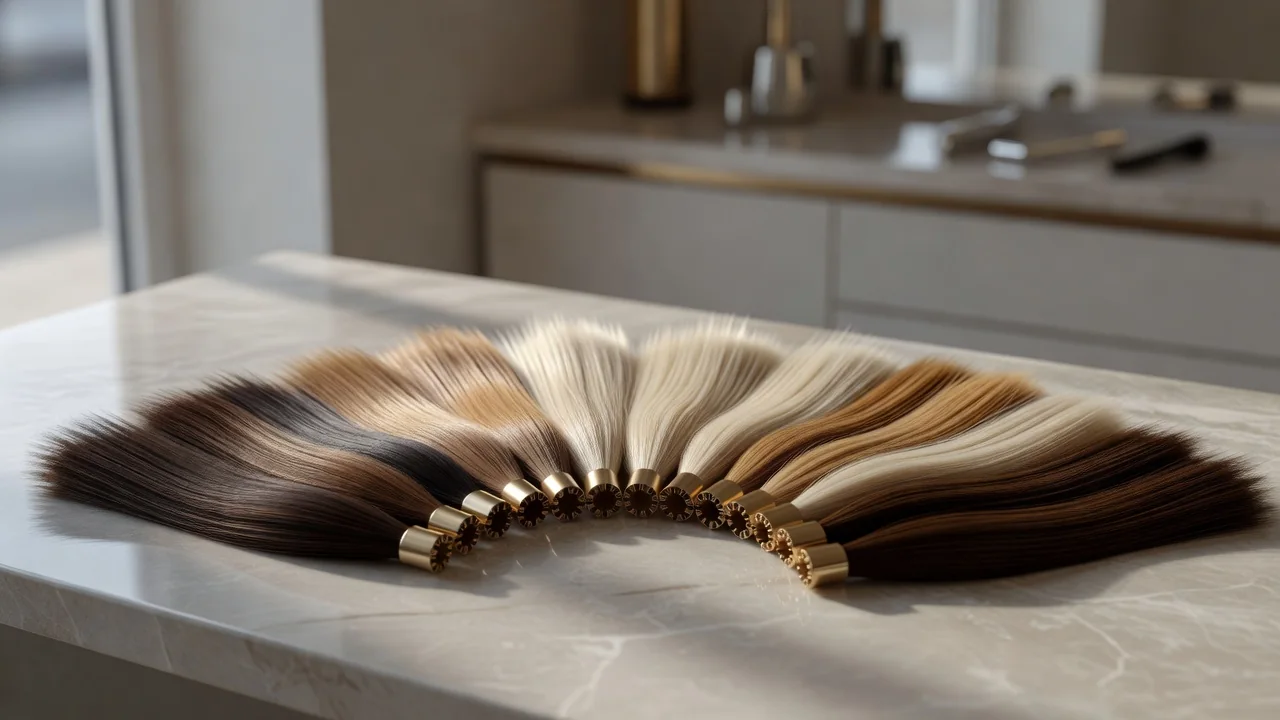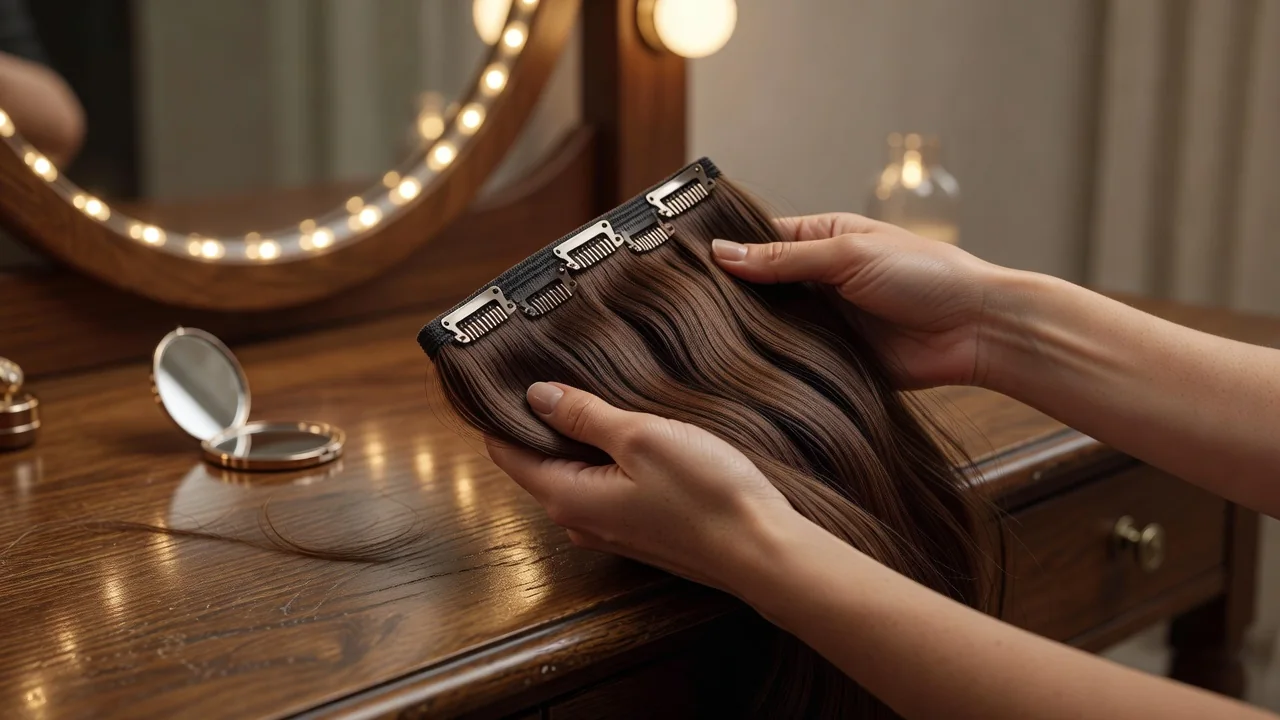
Tape-in extensions quantity: how many pieces to buy
Every tape-in extension purchase begins with the same question, and most people answer it wrong. They open a seller's page, see a 40-piece set advertised as "full head," and assume that full head means full head for everyone. What they discover three weeks later is that 40 wefts on medium-density hair looks like someone else's hair — thick, heavy, and unmistakably not growing from their own scalp. The quantity of tape-in wefts that produces natural fullness is not a number — it is a relationship between the wefts and the hair they are being added to, and that relationship depends on natural density, hair length, weft width, desired result, and a factor that almost no one considers: the natural hair's ability to carry the weight without showing bonds. A person with thick, shoulder-length hair needs a different number of wefts than a person with fine, waist-length hair, even if both want the same level of fullness. Getting the number right is the difference between extensions that look like your hair and extensions that look like extensions — and the difference is measurable in wefts, grams, and the quiet confidence of a count that matches the head it is on.
What determines the right number of wefts
The number of tape-in pieces needed for a natural-looking install is not a fixed figure — it is the product of five variables that interact with each other. Understanding these variables is the difference between buying the right quantity and buying the quantity the seller wants you to buy.
Natural hair density
Density refers to the number of individual hairs on the scalp per square centimeter. Hair density falls into three broad categories: low (fewer than 170 hairs per square centimeter), medium (170 to 220), and high (more than 220). Density determines how much extension hair is needed to create the illusion of fullness and how many wefts the natural hair can conceal.
A person with high density has thick natural hair that needs fewer wefts to achieve fullness — the natural hair already provides volume, and extensions are used to add length or subtle thickness. A person with low density has thin natural hair that needs more wefts to create the appearance of fullness — but fewer wefts that the hair can hide without the bonds showing. This paradox is the core challenge of low-density extension application: you need more wefts to achieve the look but can safely place fewer.
Natural hair length
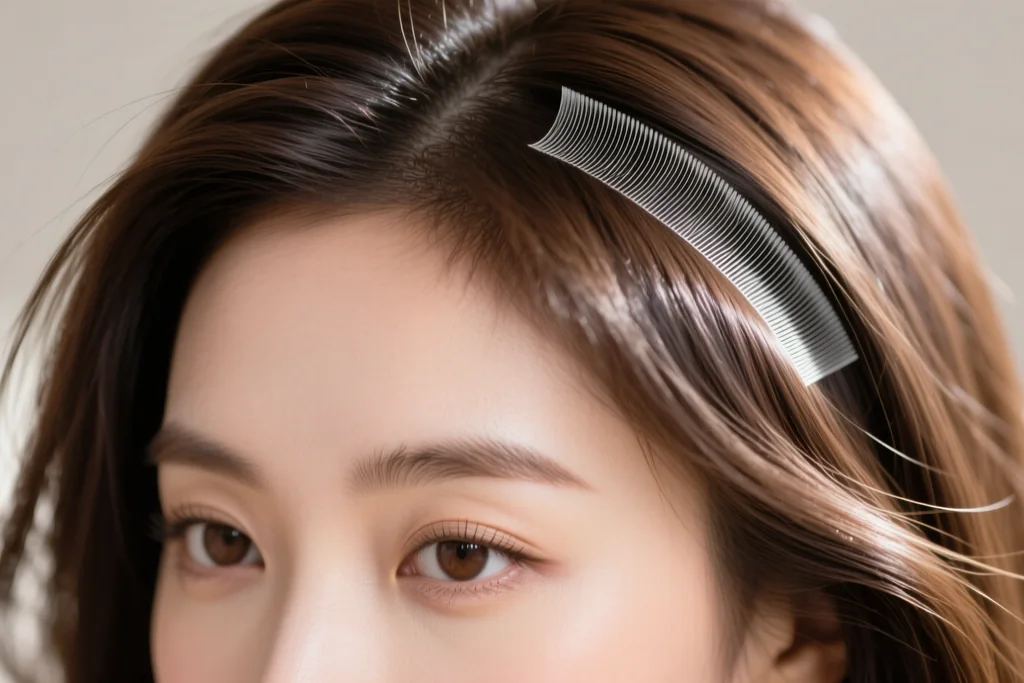
The length of the natural hair determines how much extension hair is needed to blend. Short natural hair — above the chin — requires more wefts because each weft is visible against the shorter hair and must be carefully staggered to avoid a blunt line where extension hair meets natural hair. Medium-length hair — chin to shoulder — needs a moderate number, because the natural length provides some blending. Long hair — past the shoulders — needs fewer wefts for fullness but may need more for length, and the weight of long extension hair puts more strain on each bond.
The blending challenge is the key variable. If the natural hair is 12 inches long and the extensions are 18 inches, the 6-inch difference creates a visible line unless enough wefts are placed at multiple levels to create a gradient. If the natural hair is 18 inches and the extensions are 20 inches, the 2-inch difference blends with minimal wefts because the lengths are close enough that the transition is invisible.
Weft width
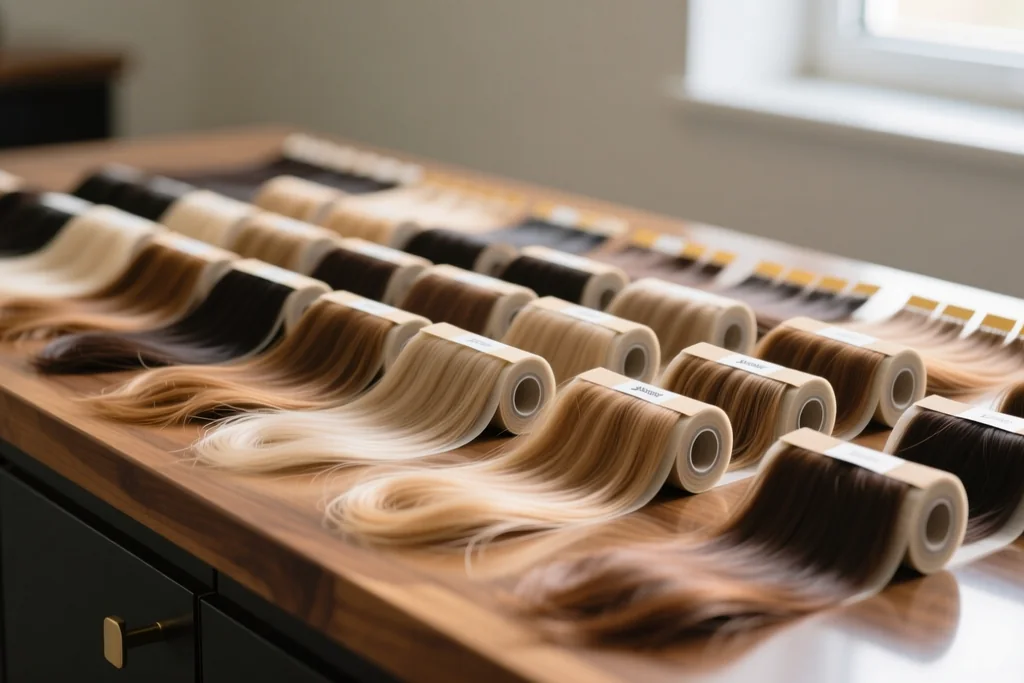
Standard tape-in wefts are 1.5 inches wide. Mini wefts are 0.5 to 0.75 inches wide. The width of the weft determines how much coverage each piece provides and how many pieces are needed for a full row. A row that needs 9 inches of coverage requires 6 standard wefts or 12 to 18 mini wefts. The choice of weft width affects both the total count and the visibility: mini wefts are easier to hide in sparse areas but require more pieces, while standard wefts provide faster coverage but may be too wide for areas near the hairline.
Desired result
The goal of the install — volume, length, or both — determines the count. An install focused on volume adds wefts where the hair is flattest — the crown, the sides — and uses fewer wefts in the back where the hair naturally has more body. An install focused on length adds wefts uniformly across the head to create a consistent length increase. An install focused on both volume and length requires the most wefts because it needs coverage across the entire head plus concentration in volume-deficient areas.
Bond visibility
This is the factor that most buyers ignore. The number of wefts you can place is limited not by what you want but by what your natural hair can hide. If you have fine hair and place 35 standard wefts, the bonds will show through the thin natural hair above each weft — regardless of how carefully they are placed. The count must be constrained by the hair's ability to cover the bonds, not by the desired level of fullness.
The standard quantity ranges
Despite the variability, there are established ranges that serve as starting points. These ranges assume standard 1.5-inch wefts and human Remy hair of medium weight (2 to 2.5 grams per weft).
For someone with low-density fine hair seeking natural fullness — not dramatic transformation — 15 to 20 wefts is the range that produces a noticeable but believable increase. This count uses primarily mini wefts at the temples and crown and standard wefts in the mid-back, with 3 to 4 rows spaced 1.5 to 2 inches apart. Going above 20 wefts on low-density hair risks bond visibility and root traction.
For someone with medium-density hair seeking visible fullness and length, 25 to 30 wefts is the range that creates a clear but natural result. This count uses standard wefts across 4 to 5 rows, with mini wefts at the temples for blending. The natural hair provides enough coverage to hide the bonds, and the density allows for a fuller result without looking overloaded.
For someone with high-density hair seeking length extension or significant volume, 35 to 40 wefts is the range. High-density hair can conceal a large number of bonds and benefits from more wefts to match the natural thickness — too few wefts in thick hair creates a visible transition where the extension hair is thinner than the natural hair, making the extensions look like a mismatch rather than a seamless addition.
How hair length changes the count
The desired final length — not the natural length — is what determines how much hair you need and, consequently, how many wefts. Longer extension hair weighs more per weft, and more wefts are needed to create a natural gradient from the natural length to the extension length.
To give a clearer picture of how the desired length and natural hair type interact to determine the number of wefts needed, it helps to see the ranges organized by starting point and goal.
The number of wefts needed varies substantially depending on the natural hair length and the desired final result, and comparing these scenarios side by side reveals the practical ranges.
| Natural hair length | Goal | Natural density | Recommended weft count | Weft type mix | Rows |
|---|---|---|---|---|---|
| Short (above chin) | Length + volume | Low | 20–25 | Mostly mini + some standard | 4–5 |
| Short (above chin) | Length + volume | Medium | 25–30 | Standard + mini at temples | 4–5 |
| Short (above chin) | Length + volume | High | 30–35 | Standard | 5 |
| Medium (chin to shoulder) | Volume only | Low | 15–18 | Mostly mini | 3–4 |
| Medium (chin to shoulder) | Volume + length | Medium | 25–30 | Standard + mini | 4–5 |
| Medium (chin to shoulder) | Volume + length | High | 30–40 | Standard | 5 |
| Long (past shoulders) | Volume only | Low | 12–15 | Mini | 3 |
| Long (past shoulders) | Volume + slight length | Medium | 20–25 | Standard + mini | 4 |
| Long (past shoulders) | Length + volume | High | 30–40 | Standard | 5 |
The ranges shown here are starting points, not prescriptions. A person with medium-density, medium-length hair who wants volume only may find that 18 wefts is perfect, while another with the same profile finds that 22 is needed because their natural hair has less body. The table provides the neighborhood; personal trial and adjustment within the range provides the exact number.
The weight factor: total grams matter as much as count
The number of wefts is only half the equation. The other half is the weight of each weft, which determines the total weight the natural hair carries. Two installs with 25 wefts each can have dramatically different total weights if one uses lightweight wefts (1.5 grams each, 37.5 grams total) and the other uses standard wefts (2.5 grams each, 62.5 grams total).
For natural fullness — not dramatic transformation — the total weight should stay within a range that the natural hair can carry without sustained traction. Low-density hair should not carry more than 40 to 50 grams of extension hair. Medium-density hair can carry 50 to 75 grams. High-density hair can carry 75 to 100 grams. These limits are not arbitrary — they are based on the tensile capacity of the follicles and the cumulative weight that the scalp supports over weeks of wear.
When selecting wefts, check the weight per piece, not just the count. A seller advertising "40 pieces, 100 grams" is selling wefts of 2.5 grams each — appropriate for high-density hair but potentially too heavy for fine hair. A seller advertising "20 pieces, 40 grams" is selling wefts of 2 grams each — lighter and more appropriate for fine to medium hair.
Where placement changes the count
The number of wefts is not the only variable — where they go matters as much as how many there are. A well-placed 20-weft install can look fuller and more natural than a poorly placed 30-weft install, because placement controls where the volume appears and where the bonds are hidden.
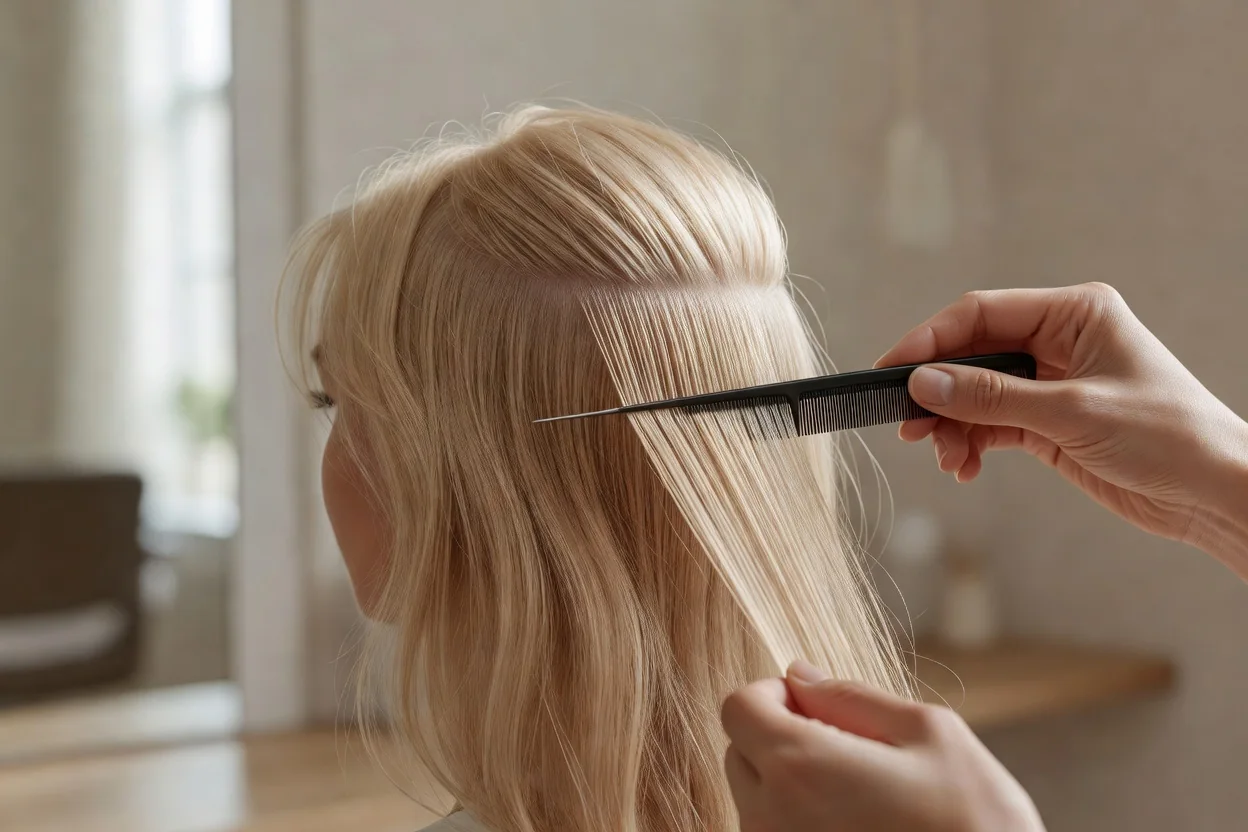
The back of the head — from the nape to the occipital bone — is the area that can hold the most wefts. The natural hair here is typically the densest, and the curvature of the skull provides coverage. This is where the majority of wefts go: 50 to 60 percent of the total count. The sides — from the temple to behind the ear — need fewer wefts and smaller wefts, because the hair is thinner and the bonds are more visible. This area gets 20 to 30 percent of the count, using mini wefts. The crown gets 10 to 20 percent, placed in a U-pattern for volume without visible bonds at the top.
Adjusting the count by area means that a 25-weft install might have 12 wefts in the back, 8 on the sides, and 5 at the crown. Redistributing to 15 in the back, 6 on the sides, and 4 at the crown changes the look — more length and less volume — without changing the total count. The count is the budget; placement is how it is spent.
How to calculate your personal count
Working through the variables to arrive at a specific number requires a systematic approach rather than a guess. The process begins with an honest assessment of your natural hair and ends with a number that you can buy with confidence.
Before ordering your wefts, work through the following steps to arrive at a count that matches your hair rather than a generic recommendation.
Steps to calculate your personal tape-in weft count:
- Assess your natural density — part your hair at the crown and look at the scalp. If the scalp is easily visible through the hair, density is low. If it is partially visible, density is medium. If it is barely visible, density is high. This assessment determines your coverage capacity and the maximum number of wefts your hair can hide.
- Measure your natural hair length — measure from the crown to the longest point of your hair, with the hair pulled straight. This measurement determines the blending challenge and the minimum length of extension hair you need.
- Define your goal — decide whether you want volume, length, or both. Volume requires wefts concentrated at the crown and sides. Length requires wefts distributed uniformly. Both requires the most wefts.
- Determine your desired final length — the length of the extension hair affects the weight per weft. Longer hair is heavier, and the count must account for the additional weight. If you want 22-inch extensions and your hair is 14 inches, each weft is heavier than if you wanted 18-inch extensions.
- Calculate your weight limit — multiply your density assessment by the weight limits: low (40–50 g), medium (50–75 g), high (75–100 g). This is the total weight of extension hair your scalp can carry without sustained traction.
- Divide weight by weft weight — divide your weight limit by the weight per weft (check the product specifications). If your limit is 50 grams and the wefts are 2 grams each, your maximum count is 25 wefts.
- Adjust for weft width mix — if you plan to use mini wefts at the temples and crown, account for the fact that mini wefts are lighter (typically 1 to 1.2 grams each). The count of mini wefts can be higher without exceeding the weight limit.
- Reduce the count by 15 percent for safety — the calculated maximum is the upper limit. For a first install, buy 85 percent of the maximum to leave room for adjustment. It is easier to add wefts later than to remove and return them.
- Buy one extra pack for replacements — wefts can fail, be placed incorrectly, or need replacement during the wear period. Having 3 to 5 extra wefts ensures you can replace without waiting for a new order.
- Track the result and adjust next time — after 2 weeks of wear, assess: are the bonds visible? Is the volume enough? Is the scalp sore? Use this assessment to adjust the count for the next install — add or remove 2 to 3 wefts based on what you observed.
Following this process produces a number that is specific to your hair, not a generic recommendation from a seller. The person who calculates their count buys the right amount the first time; the person who buys a pre-packaged "full head" set buys someone else's number and spends the wear period either hiding excess wefts or wishing they had more.
The mini weft factor: why piece count alone is misleading
Comparing counts without accounting for weft width leads to bad decisions. A 20-piece set of standard wefts covers approximately 30 inches of row length — enough for 4 to 5 full rows. A 20-piece set of mini wefts covers approximately 10 to 15 inches — enough for 3 partial rows. The same number of pieces produces dramatically different coverage depending on the weft width.
Most installs use a mix of standard and mini wefts, and the ratio affects the count. An install that uses 15 standard wefts and 10 mini wefts has 25 total pieces but the coverage and weight are different from 25 standard wefts alone. When comparing sets or recommendations, always check the weft width, not just the piece count.
Signs you bought too many wefts
Overbuying is the more common error — sellers encourage it, and the desire for maximum fullness drives it. The signs that you have too many wefts appear within the first week of wear, and recognizing them allows you to remove excess wefts before they cause damage.
Before assuming your install is complete, check for these indicators that you have more wefts than your hair needs or can support.
Signs you have too many tape-in wefts for your hair:
- Bonds visible through the natural hair — if you can see the weft edges when you look at your hair in normal lighting, there are too many wefts for your density to conceal. Remove wefts from the rows where bonds are most visible, typically the crown and temple areas.
- Scalp soreness that persists beyond 72 hours — some soreness is normal in the first 2 days as the scalp adjusts to the weight. Soreness that continues after 3 days means the follicles are under too much tension, and the total weight needs to be reduced.
- The hair looks thicker at the roots than at the ends — a natural-looking install has a consistent thickness from root to end. If the hair looks bulkiest near the scalp, there are too many wefts placed too close together, creating a top-heavy look.
- Difficulty pulling hair into a ponytail — a natural install should allow the same styling options as your own hair. If the hair is too thick to pull into a normal ponytail, the count is too high for your natural volume.
- Headaches within the first few days — tension headaches from extension weight are a signal that the follicles and scalp fascia are under strain. The weight — and therefore the count — needs to be reduced.
- The extensions feel heavy when you shake your head — a well-balanced install is felt but not burdensome. If the hair feels weighted when you move your head, the total weight exceeds what your scalp comfortably carries.
Any one of these signs is a reason to remove 3 to 5 wefts and reassess. Removing is always an option — it is better to start with more and remove than to start with too few and wish for more, but only if you recognize the signs of excess and act on them rather than enduring weeks of discomfort and potential traction.
Signs you bought too few wefts
Underbuying is less common but occurs when someone with medium to thick hair buys a 15-piece set expecting full coverage. The result is extensions that look like strips of hair rather than a seamless blend — visible rows with natural hair in between that create a striped rather than uniform appearance.
If the extensions are not visible but the result is thinner than expected, the count was too low for the desired fullness. Adding 5 to 10 wefts at the next reapplication solves the problem. The key is to distinguish between "natural" and "thin" — natural fullness means the hair looks like it grew that way; thin means the extensions are not contributing enough to make a visible difference.
How the count changes over time
The count that works for a first install may not be the count that works for subsequent installs — and not because the hair changes, but because the wearer's expectations and skills change. A first-time wearer who starts with 20 wefts may find that the result is more dramatic than expected and reduce to 15 at the next application. Conversely, a wearer who started with 15 and found the result too subtle may increase to 22.
The count also changes as the natural hair grows. After 6 to 8 weeks, the natural hair is longer and the bonds have moved away from the scalp, creating a gap between the weft and the head. At reapplication, the wearer has the option to add wefts to fill the gap or maintain the same count. Adding 2 to 3 wefts per reapplication cycle is common as the natural hair grows longer and the desired length increases.
The number that is right for you
There is no universal answer to how many tape-in pieces produce natural fullness — but there is a specific answer for each person, and finding it requires understanding the variables, calculating the personal count, and being willing to adjust. The person who buys a 40-piece set because the label says "full head" is buying a number. The person who assesses their density, defines their goal, calculates their weight limit, and adjusts for weft width is buying a result. The number is the same word — pieces — but one is a guess and the other is a decision. Natural fullness is not 20 pieces or 30 pieces or 40 pieces. It is the number that, when placed on your head, looks like your hair — only more of it. And that number is knowable, calculable, and repeatable, if you know what to measure and how to count.